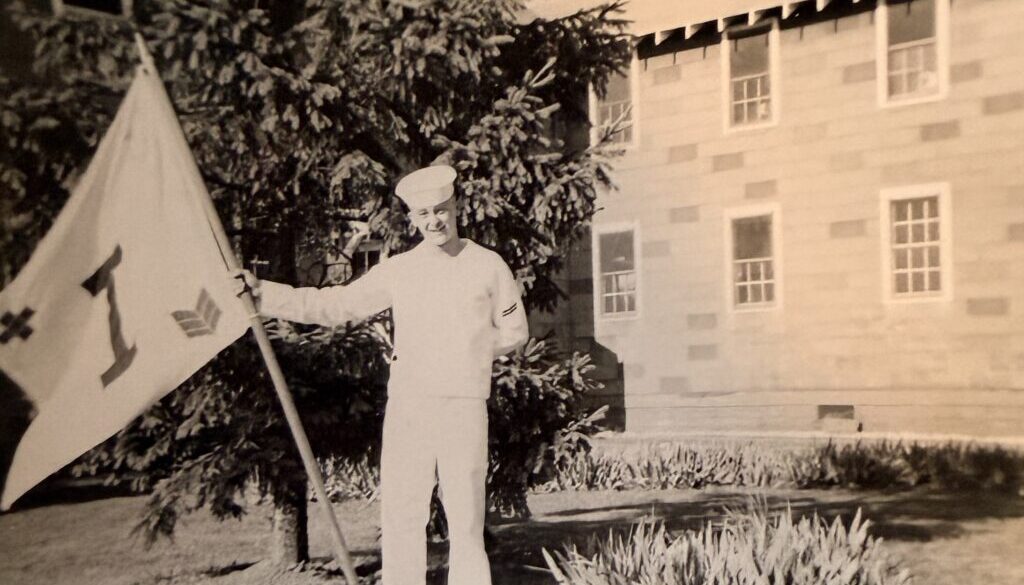
Electrician’s Mate Third Class Lyman K. “Manny” Steil, U.S. Navy – Duty in a Diesel Submarine
Few veterans are ambivalent about their military service. Many see it as the defining moment in their lives, transforming them from teenagers into adults. Electrician’s Mate Third Class Lyman K. “Manny” Steil, U.S. Navy, is certain his time in the military helped mold him into the person he is today. The four years he served in the Navy made him disciplined, taught him how to handle significant responsibility, and gave him the skills he needed to work with people from many different walks of life. After his enlistment, Manny used the lessons he learned in the Navy to further his education, teach, and build a successful career in public speaking.
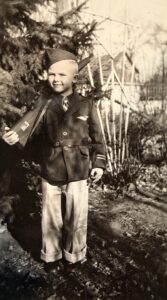
Manny was born in 1938 in Albert Lea, Minnesota, a small town of just over 11,000 people located about ninety miles south of Minneapolis. Manny’s father worked for the Land O’Lakes Company—famous for its butter—while his mother stayed at home to take care of Manny and his older sister and two younger brothers. Growing up, Manny played sports with all the other kids in his neighborhood and was active in the Boy Scouts. He got his first paid job when he was just five, helping to weed around and then paint the Land O’Lakes sign in front of its production facility on the north side of Albert Lea. From there he progressed to delivering papers, cutting lawns, and shoveling snow to make sure he had the spending money he needed throughout his school years.
When it came time for high school, Manny attended Albert Lea High. He sang in the choir, wrestled, and played intramural football, basketball, and baseball throughout his four years there. As he started to think about life after his senior year, his thoughts naturally turned to the military because the draft was a reality of life for young men in the 1950s. That meant if he was drafted, he would have to serve two years on active duty, most likely in the Army because the Army had the greatest need for draftees.
Several factors weighed into Manny’s service-selection calculus. He had the option to enlist for four years in the service of his choice now, removing the possibility he would be drafted into the Army or Marines. Or he could attend college first and defer his draft eligibility until after he’d earned his bachelor’s degree. He found that option unattractive because it merely postponed his choice but did not resolve it. Finally, he knew an older boy who had lived on his street and joined the Navy. Every time his neighbor came home on leave, he regaled Manny and the other boys on the street with his Navy stories, painting a compelling picture of life at sea. That was enough for Manny and twenty-one other boys in his class, and they decided to enlist in the Navy.
Manny graduated from Albert Lea High School in June 1956. One month later, he and the other Navy recruits from his class reported to the Armed Forces Examining and Entrance Station in Minneapolis to begin their enlistments. After passing their final physicals and taking their oath of enlistment, they boarded a bus and headed to boot camp at Naval Training Center, Great Lakes, located just north of Chicago, Illinois.
Boot camp turned out to be just what Manny expected. Soon he found himself marching around the base, learning the fundamentals of being a sailor at sea, exercising throughout the day, and doing mundane work like cleaning toilets with a toothbrush. His key to success was to say “yes, sir,” and do everything he was told to do with a smile. It did him no good to complain anyway, and he appreciated that the petty officers over him were working hard to instill a sense of discipline, duty, and camaraderie in him and the other recruits. He also excelled at the physical training because he had played sports throughout high school. In the end, his attitude, his physical ability, and his twenty-one buddies from high school made the boot camp experience go by without a hitch.
Back when Manny had enlisted, the recruiter promised him a career field in electronics. Once Manny graduated from boot camp, the Navy honored that promise by sending him to “A School” to become an electrician’s mate. Manny agreed that was close enough to electronics, so he moved to another section of Naval Training Center Great Lakes to begin his basic electrician’s mate training. However, because of his graduation timing, he and two other new sailors had about a month to wait until the class began.
To keep them from being idle, the Navy assigned Manny and his two shipmates to temporary jobs. Because his shipmates were big and brawny, they were assigned to a crew moving furniture around the base. Manny, who had a slighter build, was assigned as a driver to transport senior officials wherever they needed to go. On one occasion, Manny was tasked to drive an official who knew him from boot camp. The official recognized Manny, and asked, “Steil, how the hell did you get this job? I’ve been in the Navy for a long time, and I’d kill for a job like this.” Even better, Manny lived off base, so he could wear civilian clothes after work and on weekends. He took advantage of his newfound freedom by hitchhiking back to Albert Lea and Minneapolis on weekends to visit his family and friends.
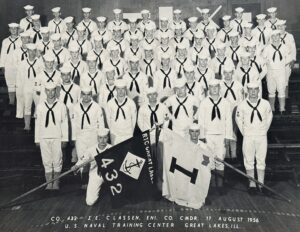
The easy life came to an end when Manny began Electrician’s Mate A School. There he learned how to work with electricity, especially in the context of a ship’s generators and its lighting and other electrical system equipment. After basic electricity training at A School, he immediately transitioned to more advanced electrician’s mate training at “C School,” which was also held at Naval Training Center Great Lakes.
According to tradition, whoever graduated at the top of the class from C School would be given their choice for their follow-on assignment. However, the sailor who graduated first in Manny’s class was a fleet sailor whose ship had sent him to the school for advanced training. Because that sailor had to return to his ship after graduation, the runner-up in the class got to step into his shoes and make their duty station request. That runner up was Manny, so he requested duty on an aircraft carrier homeported in San Diego. Instead, the Navy assigned him to Submarine School, located at Naval Submarine Base New London in Groton, Connecticut.
Submarine School was particularly challenging because it was designed to weed out sailors who could not handle the claustrophobic quarters of a submarine that spent significant time submerged, possibly while under attack. Manny’s most difficult test was the 100-foot water tower. For this test, he was placed in a room about the size of an elevator adjacent to the water tower with five other students, all wearing life vests. After the hatch to the room closed, the room slowly filled with water all the way up to their necks. They were then instructed to go through another hatch one at a time into the water tower, where they had to get to the surface, blowing air out of their lungs all the way to the top. If they instead held their breath, the reduction in pressure caused by their ascent would burst their lungs. Manny did exactly as instructed and passed the test. Every year, some sailors did not, and their failure sometimes cost them their lives.
Although critically important, survival skills weren’t the only lessons Manny learned at Submarine School. He also became generally familiar with a submarine’s electrical systems, diesel engines, and weapons systems; practiced basic damage control skills; and learned how to stand watch. Although much of the instruction occurred in the classroom, he also got underway on submarines for short training excursions, giving him the opportunity to practice what he learned under the watchful eye of experienced submariners.
Manny graduated from Submarine School during the first half of 1957 and received orders to the USS Grouper (SSK-214), also located at Naval Submarine Base New London. The Grouper was a World War II-era Gato-class diesel submarine modified in the early 1950s by adding a snorkel for enhanced underwater operations and state-of-the-art sonar and radar.[1] Manny was initially assigned a rack in the forward torpedo room, which meant he slept right next to one of the boat’s massive torpedoes. His rack was one of three stacked vertically, with so little space in between that he had to decide before he crawled in whether to sleep on his stomach or his back. He soon acclimated to his berthing situation, sleeping there both when the submarine was in port and later when it got underway.
Manny’s primary duties underway centered around maintaining the boat’s electrical systems. A significant component of those systems was the boat’s batteries, which powered the boat when it was submerged and not snorkeling air from the surface to allow the diesel engines to run. To maintain the batteries in working order while underway, Manny had to open a hatch on the floor and crawl into the battery compartment to visually inspect the rows of batteries and check their water levels. When he emerged from the compartment, his pants were often in tatters, eaten by battery acid pervasive in the compartment.
Another important duty Manny had while the boat was underway involved standing watch in the control room, where he and a watchmate helped operate the boat’s propulsion system. When they received orders from the captain to change the boat’s direction, speed, or depth, Manny and his watchmate adjusted the boat’s electric propulsion motors to carry out the captain’s orders.
These duties highlighted the importance of Manny and every other member of the submarine’s crew. Each of the sailors assigned to the Grouper had a specific job to do based on their rating, or occupational specialty, and training. If anyone failed, it put everyone at risk. Working under such conditions, the crew became very close and looked out for one another, always lending a helping hand whenever anyone needed assistance.
Never did that come into focus more for Manny than when the Grouper deployed to Europe on September 1, 1957, for naval exercises with NATO. After a short stop in Iceland on the trip across the Atlantic and port visits in Le Havre, France, and Portland, England, the Grouper got underway on October 10 with other U.S. submarines to participate in Exercise Pipedown. Grouper’s mission in the exercise was to penetrate a screen of destroyers protecting an aircraft carrier and then simulate an attack on the high-value ship.
On the afternoon of October 14, the Grouper got its chance when it came to periscope depth and sighted one of the carrier’s escorts.[2] It conducted a simulated attack on the escort, documenting it had done so by firing green flares in the escort’s direction. Still submerged and using its periscope, the Grouper then sighted the aircraft carrier—its ultimate objective. Before it could commence its simulated attack, an escort vessel closed in on the Grouper and dropped grenades over the side, which exploded close to the submarine. As the Grouper began to dive deeper to avoid the grenades, Manny and the rest of the crew felt a shudder amidships caused by an apparent collision with the escort. Manny was on the Grouper’s “sticks” controlling the submarine’s batteries when the collision occurred. It was the only time Manny was scared during his tour because he thought the Grouper had been badly damaged and was heading to the bottom. Instead of panicking, though, he and everyone else on the Grouper handled the situation just as they had been trained to do.
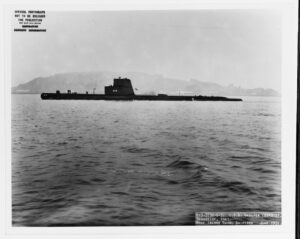
Two hours after the incident, the Grouper surfaced to inspect the damage. The crew found the submarine’s snorkel head valve housing had been “dented, warped, and torn” from the collision with the escort, the USS Haynsworth (DD-700). The Haynsworth sustained no apparent damage and no one on either vessel was injured. After the event, the Grouper sailed back to Naval Base New London, remaining on the surface for the entire voyage. It arrived safely on October 23, 1957.
One month later, Manny and the Grouper were back at sea, exercising and patrolling off the east coast of North America. For the next two years, the submarine ranged from Halifax, Nova Scotia, to the Caribbean, enhancing the crew’s warfighting skills through training and exercises. At the same time, the crew kept a watchful eye out for any Soviet ships or submarines that might ply the waters of the Western Atlantic.
During this period, Manny earned the privilege of wearing the coveted dolphins insignia after demonstrating mastery of the skills required of a submarine-qualified sailor. He also continued his electrician’s mate duties and stood watch both in port and underway. Sometimes this involved serving as a lookout on the conning tower when the Grouper sailed on the surface, while at other times he stood watch in the control room along with the other sailors navigating the submarine.
On April 24, 1958, Manny saw just how dangerous life aboard a submarine could be. During a patrol in the North Atlantic, one of Manny’s best friends lost his balance and accidentally placed his foot below a periscope that was being lowered. The periscope crushed the tip of his boot, severing his big toe. The Grouper’s corpsman, who was also the boat’s administrative yeoman, stitched the toe back on and instructed Manny’s friend to stay in bed for ten days. Unfortunately, the toe developed gangrene. As there was no way to treat the condition on the submarine, the Grouper arranged for a rendezvous at sea with an Air Force helicopter. On May 10, 1958, the helicopter lifted the injured sailor from the submarine and transported him to the hospital at Naval Station Keflavik in Iceland. Fortunately, Manny’s friend fully recovered.
Despite the dangers, life on the Grouper had its benefits. Manny always ate well because the food on the boat was excellent. Just two cooks prepared the meals in a galley so small that their outstretched arms could touch opposite walls, yet the meals were readily available to the entire crew whenever they needed to eat. When the small tables in the crew’s mess weren’t being used to eat meals, Manny used them to play cards with his buddies and write letters home. When he needed to get away from people and maybe even take a nap, he found a spot in the aft diesel engine room to relax, provided he wore ear plugs. Without them the noise in the space was unbearable, which is precisely why no one bothered him when he relaxed there.
Manny also got to make some exciting port visits. In addition to those he made during the Fall 1957 NATO exercise in Europe, he visited Halifax, Bermuda, Fort Lauderdale, Key West, and several U.S. ports in between. In February 1958, he even got to visit Havana, Cuba,[3] which at the time was still under the control of a military dictator, Fulgencia Batista.[4] Manny and his friends were permitted to go into the city wearing their civilian clothes. As they walked through a neighborhood, a man called to them from a recessed doorway to a building. When they went to see what he wanted, he opened his jacket to give them a pamphlet, revealing a holstered gun. They quickly left, discovering later that the pamphlet was recruiting material for Fidel Castro’s communist forces seeking to overthrow Batista.
On June 21, 1958, the Grouper’s mission changed from hunting enemy ships to research. In recognition of that change, the Grouper’s designation changed from SSK-214 to AGSS-214.[5] The change did not immediately impact Manny, because his electrician’s mate duties were the same under both designations. However, in November 1959, the change did impact him and the rest of the crew when the Grouper entered the Portsmouth Naval Shipyard in New Hampshire for modifications consistent with the Grouper’s new mission. The shipyard added sonar gear to the submarine and converted its forward torpedo room into a laboratory.[6] The yard period meant Manny’s seagoing days were over.
The shipyard timing was good for Manny because he was fast approaching the end of his obligated service. He received his honorable discharge in July 1960 and returned home in time to start the fall semester at the University of Minnesota. Once he began classes, he realized just how much his experience in the Navy had helped him. Not only was he four years older than most of the other students in his freshman class, but now he had the discipline he needed to do his course work and the confidence required to excel.
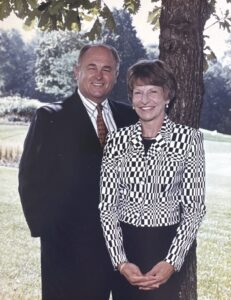
Manny’s Navy experience also taught him to use his time efficiently. This meant once he completed his course work, he had time for other pursuits. One of those was enjoying music, and one Saturday night he went to a popular bar in Minneapolis to listen to jazz. There he met DeAnna Halvorson and they started to date. They soon fell in love and were married during Manny’s junior year.
Manny graduated from the University of Minnesota in 1964. He spent a year teaching in Illinois at Lincoln Way High School and coaching the school’s debate team before obtaining his master’s degree. He subsequently taught for six years at Macalester College and for fourteen years at the University of Minnesota. After earning his Ph.D. while at the University of Minnesota, he started his own company, Communications Development, Inc., and launched a speaking and consulting career.
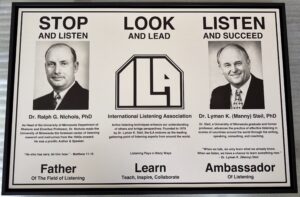
To say Manny’s speaking and consulting career was successful would be an understatement. On the speaking side, he was inducted into the National Speakers Association Hall of Fame and became world-renowned for his work in listening. In fact, he founded the International Listening Association, which spread to thirty countries, and continued to publish books and articles on listening. His most recent book, Effective Listening Every Day, was released in November 2024. On the consulting side, Manny conducted over 10,000 personality assessments and profiles for families, organizations, major corporations, and every branch of the U.S. military.
Manny and DeAnna eventually settled in the Minneapolis metropolitan area. They had three children (Scott, Sara, and Stacy) and six grandchildren. Sadly, DeAnna passed away in 2012 after being married to Manny for forty-eight years. Now Manny enjoys distributing awards to deserving Albert Lea students from the many endowed scholarships he created with DeAnna and other proud alumni from the school. He also enjoys spending time with his children and grandchildren and continuing his work on the importance of listening.
Voices to Veterans is proud to salute Electrician’s Mate Third Class Lyman K. “Manny” Steil, U.S. Navy, for his service on board the USS Grouper. Using the tools he gained from his experience in the Navy, he built a successful career speaking and consulting and changing the way we think about listening. His work now touches countless lives all over the world. We thank Manny for all he has done and wish him fair winds and following seas.
If you enjoyed Manny’s story, please sign up for the Voices to Veterans Spotlight monthly newsletter by clicking here. Once each month, you’ll receive a new written veteran’s story directly in your mailbox. Best of all, it’s free and you can unsubscribe at any time.
[1] The USS Grouper was commissioned on February 12, 1942. The submarine completed nine war patrols in the Pacific Campaign during World War II. “USS Grouper,” Wikipedia, last modified March 19, 2026, https://en.wikipedia.org/wiki/USS_Grouper.
[2] See the USS Grouper (SSK-214), Deck Log, October 14, 1957, Record Group 24: Records of the Bureau of Naval Personnel, National Archives, accessed March 18, 2026, https://www.archives.gov/research/military/logbooks/navy-online.
[3] USS Grouper (SSK-214), Deck Log, February 7–10, 1958.
[4] “Fulgencio Batista,” Wikipedia, last modified March 18, 2026, https://en.wikipedia.org/wiki/Fulgencio_Batista.
[5] USS Grouper (SSK-214), Deck Log, June 21, 1958.
[6] USS Grouper,” Wikipedia.