Learning to Live from Those Willing to Die

Military service changes lives.
Let the stories in Learning to Live from Those Willing to Die change you, too.
Learning to Live from Those Willing to Die will help you navigate life’s challenges using the lives of veterans to reveal important lessons about character and humanity.
Each of the book’s fourteen chapters begins by identifying an important life lesson such as, “If you don’t see a path, blaze a trail,” or “Don’t accept adversity, challenge it.” The chapter then includes one or more veterans’ life stories to illustrate the lesson.
From manning the deck of an aircraft carrier during a Japanese kamikaze attack, to patrolling through the dense jungles of Vietnam, to riding in an armored vehicle across the Iraqi desert, Learning to Live from Those Willing to Die portrays the gamut of wartime and peacetime service.
The veterans’ stories in Learning to Live from Those Willing to Die highlight the ordinary yet extraordinary lives of twenty-two men and four women. The stories feature combat and non-combat veterans who served in World War II, the Vietnam War, Operation Desert Storm, the Iraq War, the Cold War, and/or America’s peacetime military.
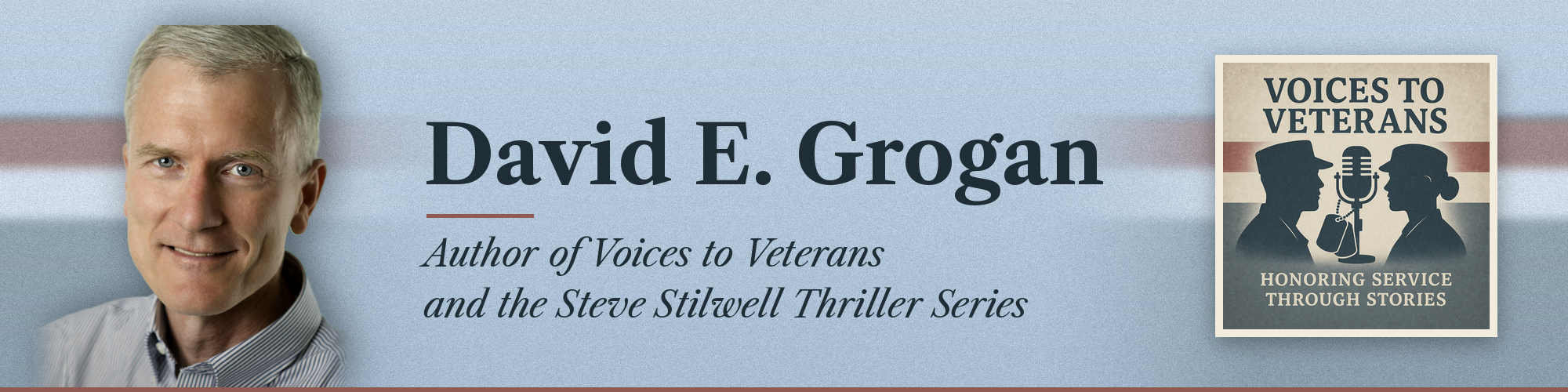
Author David E. Grogan, a retired Navy captain with over two decades of military service and an award-winning author, presents the veteran experience—and the lessons you can derive from it—in an authentic and credible way. He has been interviewing veterans and publishing their stories through his Voices to Veterans blog since 2017.
When you purchase Learning to Live from Those Willing to Die,  you will be directly helping veterans:
- All Amazon author royalties for Learning to Live from Those Willing to Die are donated to America’s VetDogs, which provides guide and service dogs to veterans and first responders.
- So far, Learning to Live from Those Willing to Die has raised over $6,500 for America’s VetDogs!
After you read Learning to Live from Those Willing to Die, please leave a review on Amazon or Goodreads. Your reviews really help!
Buy Now – It’s Easy!


Excerpt from Learning to Live from Those Willing to Die
Introduction
On April 1, 2001, a Chinese fighter pilot started a chain of events that saved my life. It started at 22,000 feet over the South China Sea during a routine flight by a four-engine U.S. Navy EP-3 surveillance aircraft crewed by twenty-four sailors. As the plane was on its way home to Kadena Air Base in Okinawa, Japan, two Chinese J-8 jet fighters appeared. This was no cause for alarm—Chinese fighter intercepts like this had happened before and the EP-3 crew knew how to deal with them. They just needed to continue on their present course and speed, doing nothing to provoke a response from the Chinese. The EP-3 pilot followed his mission instructions to a tee, expecting the Chinese fighters to break off their intercept once they tired of their attempt to intimidate the Navy aircrew.
Unfortunately, Lieutenant Commander Wang Wei, the pilot of one of the Chinese fighter jets, was reading from a different playbook. After two close passes near the EP-3, he tried a third even closer approach. This time, his fighter collided with the larger U.S. Navy aircraft, causing his plane to plummet into the sea. Lieutenant Commander Wang did not survive. The EP-3 took a similar nosedive after sustaining significant damage during the collision. Only the skill of the pilot, Lieutenant Shane Osborn, kept the plane from crashing with the possible loss of the entire crew.
Although Lieutenant Osborn kept the plane flying, he needed to find somewhere to land, and fast. The only option was an airfield on Hainan Island, part of the People’s Republic of China. In the frantic minutes before Lieutenant Osborn made the emergency landing, and even for some time afterward, the EP-3’s crew destroyed as much of the Top Secret surveillance data and sensitive intelligence equipment as they could before armed Chinese soldiers made it clear they had to get out of the plane. The Chinese interned the EP-3’s crew, beginning a tense ten-day standoff between the United States and China. The matter was finally resolved when the United States sent a letter to the Chinese government expressing sorrow and regret for the incident and the Chinese government released the crew from internment. The Chinese government also returned the plane several months later, albeit as dissembled parts rather than an intact aircraft.
I watched these events unfold with particular interest. At the time, I worked in the Pentagon for the Under Secretary of Defense for Policy, and my portfolio comprised all things oceans policy. Since this incident involved China’s refusal to recognize the right of the United States to fly unhindered through international airspace above an ocean, I was involved in formulating the Department of Defense’s policy response.
A major part of that response included a meeting between representatives of the U.S. Navy and the People’s Liberation Army Navy to discuss ways to lower tensions at sea and prevent incidents like this from happening again. The meeting was set for Guam, and both sides began to prepare. As I was part of the U.S. Navy delegation, that meant drafting background papers and talking points so we would be ready to authoritatively present our position to our Chinese counterparts while still looking for common ground. Since my office was in a different section of the Pentagon, I routinely visited the Navy section to meet with other delegation members to discuss our plans for the trip. On the Friday before we departed, I made one final visit to go over the arrangements. Because the Navy spaces were secure, a Navy lieutenant commander met me at the door to let me in.
My flight to Guam departed from Reagan National Airport in Washington, D.C. I left a day earlier than planned so I would not miss a delegation coordination meeting scheduled for 6:00 p.m. on Wednesday in Guam. I arrived in Guam Tuesday evening local time, grabbed something to eat, and went to bed to minimize the jet lag.
I woke up early in the morning on Wednesday after a good night’s sleep. I had nothing scheduled until the 6:00 p.m. meeting, so I turned on the morning news to see what was going on. I watched in stunned silence as the attacks on the World Trade Center Towers and the Pentagon replayed over and over again on the TV, having taken place hours before. I had slept through the entire 9/11 attack! At that moment, I felt far removed from everyone and everything. I also felt like I needed to be at the Pentagon, even though there was absolutely nothing I could do. Although I did not feel lucky, I knew I was because the hijacked plane destroyed the Navy section of the Pentagon. The lieutenant commander who opened the door so I could attend the final meeting before I left was killed in the attack. Given my frequent visits to the Navy section, had I not been in Guam to negotiate with the Chinese, I could have easily been killed, too. In a very real sense, Lieutenant Commander Wang Wei saved my life.
My wife’s 9/11 experience was completely different. While I was safe over 12,000 miles away in Guam, Sharon and our three children were in the thick of Northern Virginia’s reaction to the terrorist attacks. Not only was she concerned about keeping our kids safe, but she also worried about our many military friends who had family members working in the Pentagon. She answered numerous calls from family and friends who thought I was in the Pentagon at the time of the attack, causing her to relive the tension with every ring of the phone. Yet the impact on our family was miniscule compared to those who had family members killed or injured in the Pentagon; New York City; and Shanksville, Pennsylvania.
I have told this story to very few people primarily because of the disconnectedness and perhaps guilt I feel for not having been in the Pentagon on 9/11. Yet there is so much to unpack and learn from the story. Obvious lessons include the fickleness of fate, the fragility of life, and the need to live every day as if it is the one that matters most. But there is so much more there when I dig deeper below the surface. I should have appreciated more than I already did the deep bonds of friendship I’d formed with my many military colleagues and thanked them for their service at every opportunity. After all, the events of 9/11 made it clear that military members, even in the United States, are always at risk. I also should have viewed the experience as an opportunity to step away from my workaholic ways to be more devoted to my family. Yet, because I felt detached from the 9/11 experience, I failed to recognize the opportunity or appreciate what they had gone through.
Looking back, I wish I had taken the time to tell this story—at least to my kids—not only so they would have learned more about me, but also because it would have caused me to reflect on those days and the lessons I should have learned. For better or worse, my kids didn’t have to listen to me regale them with stories. They simply saw me leave for work in the morning wearing a uniform and return home at night wearing the same before I changed into civilian clothes. For them, the Navy was just my job, and a job that took me away from them, sometimes for as long as a year-and-a-half. And, because we lived in Navy towns, lots of their friends’ moms and dads did the same thing, so they accepted this was the way families lived.
Something I did tell them about, though, was my love and respect for veterans. One way I conveyed my passion was through a family tradition we started on the Saturday of every Memorial Day weekend. We would get up early and head to the nearest American Legion Post, where we joined other similarly minded individuals in putting American flags on veterans’ graves. The kids griped about having to wake up early and give up their Saturday morning until we arrived at the cemetery to put the flags on the graves. Then they suddenly understood, even at their young age, the solemnity of what we were getting ready to do.
We took the same approach every year. Sharon and I divided the kids between us, usually keeping the girls together, and then we walked down the long rows of graves, putting a flag just below the headstones marking veterans’ graves. We made it a point to read every gravestone, either out loud or silently together, often remarking on what we saw. I can still remember a veteran’s gravestone at a Virginia Beach cemetery that made a particular impression on my son, who was perhaps in middle school at the time. It read, “He had more love than he gave and he needed more love than he got.” We discussed it with everyone driving back to the house that morning, wondering what had caused the man’s family to chisel such a remembrance into the veteran’s headstone for everyone in the community to see.
As I reflected on all the veterans’ headstones over time, I realized just how important a person’s military service is in their life. Think about it—a grave marker about two feet long and one foot wide is all that is available to capture the essence of a person’s life. Most of that free space is taken up by the person’s name and the dates they lived, leaving only a small space along the bottom edge to reflect for posterity how the individual should be remembered.
My family’s experience putting out flags taught me there are three things that either the deceased or their surviving family members want people to know about their lives. First, many graves reflect the importance of family. They indicate the deceased was a loving father, mother, husband, wife, or other special person to someone. Perhaps the lack of such a loving relationship was what was so disconcerting about the gravestone my son and I found about the veteran who couldn’t express or receive love. Second, people want to be remembered for their faith. For example, many gravestones include a cross, Star of David, or star and crescent to reflect the person’s religion and commitment to it. Finally, if the deceased is a veteran, their headstone often includes their rank, service, and any wars or campaigns they participated in.
Why is it that military service gets to take up such valuable real estate on a veteran’s headstone? What about it is so transformative that men and women, no matter whether they served out a two-year draft obligation or a thirty-year career, whether they were decorated combat veterans or peacetime support personnel, or whether they were a senior officer or a lower-ranking enlistee, want their military service to be memorialized like family relationships and faith? And, more importantly, if military service is that significant to veterans, what can we learn from their lives that might help make ours more fulfilling?
Although finding answers to those questions more broadly was not my original motivation, I began writing a blog in July 2017 called Voices to Veterans to help tell the stories of people who serve in the military. Almost every month since then I have interviewed a veteran and published their story online, focusing largely on veterans whose stories would otherwise have gone untold. My primary goals were twofold: first, to honor the veterans and, second, to help the public understand what it means to serve in the military since so few people do so now that we are in the sixth decade of the all-volunteer force. I also must confess that I initially viewed the blog as a way to give my fiction audience something to read while waiting for my next legal thriller. However, the veterans’ stories soon overtook my fiction writing and eventually supplanted it. An email from the daughter of one of the veterans whose story I’d written validated the transition. She said she sat down with her boys, and they read about what their grandfather did during the Vietnam War. They hadn’t heard the stories, and without the Voices to Veterans blog post about her father, they might never have.
That’s when I realized how important veterans’ stories are to veterans’ families and friends. Beyond that, they are important to us all because they contain life lessons. We just need to take the time to learn about veterans’ successes and failures, their hurdles and determination to overcome them, and their incredible desire to serve. For example, had I reflected timelier on my own 9/11 experience, I might have found answers to questions that would have made me a better husband, father, and Navy officer.
I have one more purpose in presenting these veterans’ stories—to preserve them. I want future generations to be able to read about the lives and service of these extraordinary people. Accordingly, I’ve included the stories largely as they originally appeared in my Voices to Veterans blog, although some have been edited for length or clarity. Because they document each veteran’s service, they often include details about the units they served in, exercises or campaigns they participated in, and people who inspired them. They also include descriptions of the difficulties they faced, their family relationships, and the historical context of their service. Some stories are short and can be read in a few minutes while others will take a half hour or so. They illustrate the point I emphasize with all the veterans I interview—every veteran has a fascinating story to tell. In fact, I read them over and over, learning something new each time and always enjoying them. I hope you do too.
Over the course of the next fourteen chapters, we will explore what makes veterans successful in peacetime and in war. You’ll soon see how these veterans could be your neighbor, your family member, or your friend. They are ordinary in every sense of the word, yet equally extraordinary. We can learn from their stories to make ourselves better people, and we can ensure their lives’ lessons are more than just an abbreviated byline on their gravestones. In short, we can learn to live from those who are willing to die.