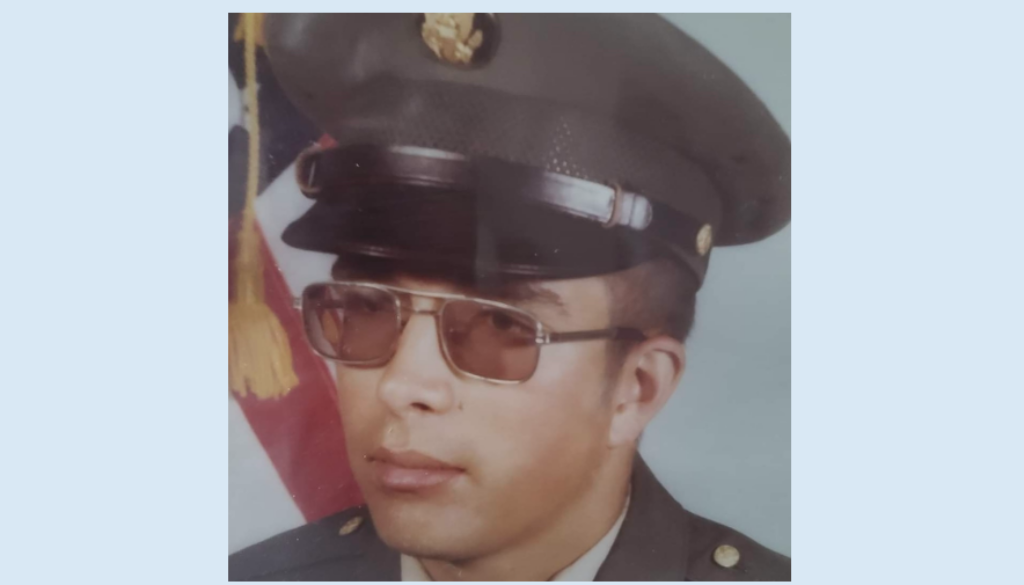
Specialist James Reinholdt, U.S. Army – Soldiering Through the Mountains and Valleys of a Five-Year Army Career
Sometimes our lives don’t go the way we envisioned. Fortune or adversity can strike at any time, sending us on a course we never imagined or prepared for. Such was the case with Specialist James Reinholdt, who served in the Army from 1978–83. Seventeen months into his dream job in Berchtesgaden, Germany, he was the driver in a fatal traffic accident that took the life of an Army colleague. He has dealt with the effects of the accident ever since. One thing he has never done, though, is give up.
James was born in 1960 in Des Moines, Iowa, and raised in the nearby town of Hartford. His mother was a stay-at-home mom who raised James and his three surviving siblings. His father worked the night shift at the Firestone Tire & Rubber Company for thirty years, missing only eight days of work during that entire time. After his father clocked out at 7:00 a.m. each morning, he drove a school bus for the Carlisle School System—the school system attended by students from Hartford. During summer break, he found other jobs to make sure the family could make ends meet, especially when employees at the Firestone plant went on strike.
James’ parents shaped his character in distinctly different ways. His father set a positive example for James because he was a good and honorable man. He worked hard and treated everyone with dignity and respect, so not only James, but also everyone in the community, loved and respected him. His mother set a positive example, too. She grew up on a farm with lots of brothers, so she was scrappy. She taught James how to deal with the hardships in life, as did her father, who was a man of deep faith. They had three principles about life they passed along to James and his siblings. First, the world can be cold and cruel. Second, life is not fair. Third, nobody owes you anything. These principles helped James become resilient and self-reliant.
As for his formal education, James attended Carlisle High School. Although he was not athletic, he lettered during his senior year as the basketball team’s manager. He also worked hard all through school in local restaurants to earn money because his parents told him if he wanted a car after he got his license, he would have to pay for it himself. Amazingly, he saved enough money by the start of his senior year to purchase a new Chevy Vega on credit, making all subsequent car, insurance, and maintenance payments on his own. Despite his busy schedule, he still did very well in school, qualifying for Mu Alpha Theta, an honor society recognizing high achievement in mathematics.
During his senior year, James started looking to his future. He thought he wanted to be a pastor, but he didn’t have enough money to go to college. He turned to the Army, enlisting in the Delayed Entry Program on January 27, 1978. His goal was to use the Veteran’s Educational Assistance Program, known as VEEP, to help him pay for college after he served his time in the Army. Even better, he enlisted as a chaplain assistant, which aligned with his desire to become a pastor after completing his Army enlistment.
James graduated from Carlisle High School in May 1978. One month later, he reported to the Military Entrance Processing Station at Fort Des Moines. There he passed his final physical and took his oath of enlistment before heading to Fort Dix, New Jersey, for basic training. He arrived not only with the principles his mother and grandfather had taught him, but also with some sage advice from his recruiter: “Do what you are supposed to do and be wherever you are supposed to be before you are supposed to be there.”
Strengthened by the guidance he’d been given, James excelled at boot camp. The only area he had trouble with was the physical training because he was not athletic. Still, he gave it everything he had, once even being singled out as an example by a drill sergeant for never giving up during an arduous push-up session. The drill sergeant’s praise made him try even harder.
Basic training gave James two new maxims to live by. The first concerned rumors, which ran rampant about all aspects of Army life. James learned never to believe anything he heard and not to believe half of what he saw until it was officially verified. Second, boot camp taught him to persevere under difficult circumstances. He knew he had two options when he faced a challenge—quit or push through—and that the world didn’t care which option he chose. However, the choice did matter to him and to his ability to live with himself going forward. This latter lesson reinforced everything his mother taught him growing up.
James graduated from basic training in September 1978. From there, he reported on Labor Day weekend to the Chaplain Center and School at Fort Wadsworth in Staten Island, New York, for Advanced Individual Training as a chaplain assistant. There he learned how to support chaplains of all faiths, including setting up worship facilities, facilitating the services for all denominations both in garrison and when deployed in the field, and running the administrative side of base chapels. The training was designed to be completed in six weeks, but participants were permitted to complete the course material at their own pace. James did so in just thirteen days, finding he had a natural talent for clerical work. After completing the training, he headed to his first assignment at Selfridge Air National Guard (ANG) Base, located about thirty miles northeast of Detroit, Michigan.
James was administratively assigned to the Tank-Automotive Command (TARCOM) at the Detroit Arsenal in Warren, Michigan. He spent little time there, instead living in the barracks at Selfridge ANG Base and working at the base chapel. In fact, only the chaplain he was officially assigned to worked at TARCOM, meaning the chaplains he worked most closely with were a Navy chaplain and Air Force reserve chaplains assigned to the Selfridge base chapel. James’ responsibilities involved setting up the chapel for worship services and handling all the chapel’s administrative responsibilities. These included typing letters, preparing the bulletins for the various services, and greeting servicemembers who wanted to talk to one of the chaplains. He also served as the funds clerk for the Chaplains’ Fund, which consisted mainly of donations collected at the chapel’s weekly services, and kept track of the chapel’s appropriated fund expenditures.
In September 1979, James took emergency leave when his father had triple bypass surgery. He called the chapel the following Sunday to check in and make sure things were going smoothly in his absence. All the chaplain he was talking to had to say was, “You really do a lot around here!” James so impressed the chaplains with his hard work and attention to detail that they extended him for six months beyond his original transfer date. When it came time to depart, everyone at the chapel pitched in to purchase and sign for him a copy of the Good News for Modern Man New Testament. James cherishes that gift because his colleagues presented it to him.
Based on his success at Selfridge, James received much sought-after orders to a follow-on assignment at the U.S. European Command Chaplain’s Office. He reported in May 1980 and was sent to the Armed Forces Recreation Center in Berchtesgaden, Germany, to assist with planning and executing the religious ministry retreats held at the facility. This was a big responsibility because every major religion represented in the U.S. European Command held a retreat at Berchtesgaden once a year, and there were two chaplains’ retreats and two chaplain assistant retreats there every year, too. James provided logistics support to all these events, including handling attendance and lodging, addressing any dietary restrictions of the attendees, setting up registration tables, and otherwise ensuring the retreats ran smoothly. When he wasn’t working the retreats, he performed the same chapel management duties for Berchtesgaden that he had at the Selfridge ANG Base chapel.
The work at Berchtesgaden allowed James to meet many famous and influential people, including the Chairman of the Joint Chiefs of Staff, the Army’s Chief and Deputy Chief of Chaplains, pianist Victor Borge, and the last man to walk on the moon, Gene Cernan. Not only did James get to meet them, but he often got to hear them speak at the retreats he assisted with.

James found much more to love about his assignment in Berchtesgaden than the job itself. He lived in the shadow of the Bavarian Alps’ second highest peak and loved hiking in the mountains and talking to the German people he met. He also enjoyed skiing in the winter, kayaking in the summer, and the many German traditions developed over the centuries. James could not have imagined a better assignment.
By the fall of 1981, James reached a decision point. His four-year enlistment would end in June 1982, so if he wanted to continue his Army career at Berchtesgaden, he had to extend his enlistment or return to civilian life when his enlistment expired. Because he enjoyed what he was doing so much, he signed an eighteen-month extension on October 1, 1981, which meant his obligated service now extended through the end of 1983. Seven days after signing the extension, his life forever changed.
On October 8, 1981, James was tasked to pick up a chaplain in Munich and drive him to Augsburg to attend a budget conference. After picking up the chaplain, James was involved in a head on collision with another vehicle and the chaplain was killed. James suffered a non-displaced fracture in his neck and three broken ribs, while the driver of the other vehicle sustained relatively minor injuries. To make the already horrific situation even worse, the German police found James at fault in the accident.
James drifted in and out of consciousness for three days and spent time in two transient hospitals before arriving at Landstuhl Army Hospital near Ramstein Air Base. He woke up with a verse from the Bible in his head—Romans 8:28, “We know that in all things God works for good with those who love him, those whom he has called according to his purpose.”[1] Although this verse brought him comfort, he was still a scared twenty-one-year-old kid lying in a hospital bed alone and far from home. He couldn’t remember what had happened, but he knew he had a broken neck and that the chaplain riding with him had died. And, because he was in Landstuhl, his friends and his command were over 200 miles away, so he had no one to talk to. When he finally was able to call his parents, he learned to his surprise that his parents had not been told anything about the accident or his injuries.
James remained in Landstuhl for over a month before being released back to his command at Berchtesgaden. In the meantime, the Army had decided to charge him with negligent homicide and pursue a trial by general court-martial. However, when the general court-martial convening authority reviewed the facts surrounding the crash, he concluded the collision was a tragic accident for which trial by court-martial would be inappropriate and dismissed all the charges against James.
All these events proved a lot for James to deal with, let alone the severe Post-Traumatic Stress Disorder (PTSD) he suffered from the death of his colleague and the accident itself. To cope with the situation, he started using alcohol. Still, he managed to continue working at Berchtesgaden until around December 1982, by which time it had become clear his PTSD and physical injuries would not allow him to serve there any longer. Accordingly, he transferred to Augsburg to work at the base chapel for six months before being sent to Fort Dix for out-processing. He was separated from the Army for medical reasons on June 14, 1983, and received an honorable discharge.
When James arrived in Hartford, Iowa, after receiving his discharge, his entire family welcomed him home. He remained with his family until the fall of 1984, when he used his vocational rehabilitation benefits to attend Concordia College in St. Paul, Minnesota. He earned his bachelor’s degree in business at Concordia, graduating in 1988. He also met his first wife there, and they had two children together. They divorced after fifteen years of marriage, often struggling because of the continuing impact of James’ severe PTSD.
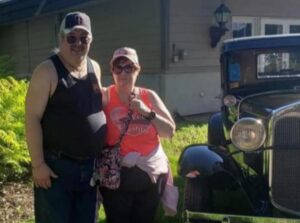
After graduating from Concordia College, James managed restaurants and worked in retail, even spending six years as a courier. Somehow, he always made ends meet and helped get both his children through college. He also earned his master’s degree in business administration from Colorado Technical University. Most important, though, he met his wife, Meredith Wille, and they have been happily married for over sixteen years. She has helped James address his PTSD, as have the mental health programs and professionals made available to him through the Veterans Administration. Above all, he has relied on his faith in God.
Despite the significant ups and downs in James’ life, he considers himself a blessed man and is thankful for all the people and events that helped shape him into the person he is today. So much so, that he reaches out to veterans struggling with mental illness and encourages them to get the professional help they need because it worked for him. He wants others to learn from his life story.
Voices to Veterans is proud to salute Specialist James Reinholdt, U.S. Army, for his service as a chaplain’s assistant from 1978–83. Despite a tragic accident that claimed the life of a dear colleague, James has soldiered on. No matter what his assignment or what the circumstances were, he has always tried to do his best, never giving up. We thank him for his service and sacrifice and wish him fair winds and following seas.
If you enjoyed James’ story, please sign up for the Voices to Veterans Spotlight monthly newsletter by clicking here. Once each month, you’ll receive a new written veteran’s story directly in your mailbox. Best of all, it’s free and you can unsubscribe at any time.
[1] Romans 8:28 (Good News for Modern Man: The New Testament in Today’s English Version, 3rd ed.; New York: American Bible Society, 1971).