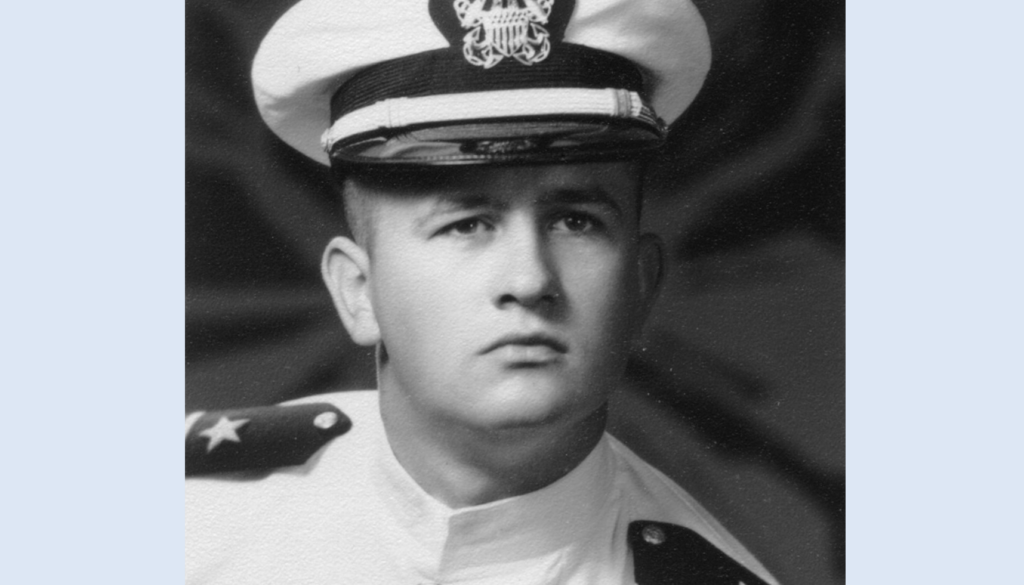
Lieutenant Walter Byron, U.S. Navy – Serving on a Destroyer in the Western Pacific
When young men and women head off to college, they have a lot of growing up to do. College helps make that happen, but it can only do so much. That’s where life experience steps in to complete the job, and no life experience does that better than service in the military. Lieutenant Walter Byron, U.S. Navy, benefitted from that experience firsthand. Just five months after graduating from Tufts University, he found himself learning to drive a multi-million-dollar destroyer across the Pacific Ocean. The responsibility he had as a junior officer matured him like nothing else could. He then parlayed his Navy experience into a successful civilian career in engineering and management.
Walter was born in Boston in 1941 and grew up in nearby Waltham. As a young boy, he and his friends were free to roam the neighborhood whenever they weren’t in school. Walter’s mother’s only admonition was to come home after the second commuter train from Boston went by their house at 5:40 p.m. He also lived close enough to his schools that he was able to walk to school all the way through his junior year at Waltham Senior High School. He rode to school with a friend during his senior year after the twelfth grade moved to a new building beyond walking distance.
To earn money during his junior and senior years, Walter worked as a cashier at a Stop & Shop grocery store. He also thought about college and how he was going to pay for it. With that in mind, he applied for a Navy Reserve Officer Training Corps (ROTC) scholarship, which would pay for his college tuition, room, board, and books. Although he was not selected for the scholarship, some of his friends were, so he decided to participate in Navy ROTC anyway as a contract student even though he would not receive any tuition assistance for doing so.
Walter graduated from Waltham Senior High in June 1958 and began his freshman year at Tufts University that fall. To cut costs, he lived at home and commuted to school one hour each way by train, tram, and bus. In addition to the courses he had to take to earn his degree in mechanical engineering, he took an array of courses in naval science because of his contract participation in ROTC. These Navy courses, which included subjects like celestial navigation and naval engineering, were just as challenging as his mechanical engineering classes. Once a week, he also had to don a wool Navy uniform and retrieve a 1903 Springfield rifle from the university gym to drill with the other midshipmen on a practice field. The combined weight of coursework, drills, and daily commuting made free time a rare commodity.
After Walter completed his first two years of ROTC, the Navy paid him a small monthly stipend for his continued participation. He also got to go with the other midshipmen in his class during the summer between his junior and senior years to Naval Station Norfolk, Virginia, where he boarded a World War II-era Dock Landing Ship for his midshipman cruise to Bermuda. During the cruise, the midshipmen rotated through the ship’s work centers, learning their functions and observing sailors doing their jobs firsthand. When Walter rotated through the ship’s pressurized fire room, the temperature was 135 degrees Fahrenheit. Walter sat in front of a blower pumping in 95-degree air from outside the ship, and it felt like heaven.
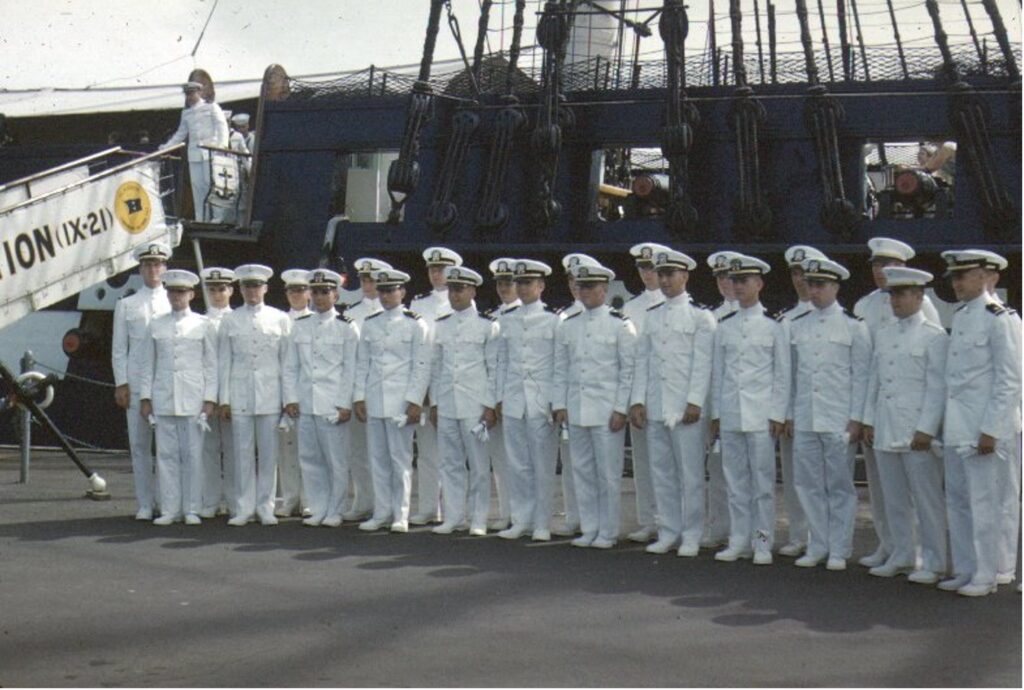
By June 1962, Walter was ready to graduate from Tufts University and begin his Navy career. Accordingly, on June 9, he and the other twenty-three midshipmen in his graduating class went aboard the historic USS Constitution to receive their commissions in the Navy or Marine Corp. Since Walter was a contract ROTC student, he received a commission as an ensign in the U.S. Navy Reserve and was obligated to serve two years on active duty and four years in the reserves. In contrast, those midshipmen who had been awarded ROTC scholarships received commissions as ensigns in the regular Navy and were obligated to serve four years on active duty and two years in the reserves. Although the regular and reserve commissions were different, the training both types of officers received was identical, and they were equally well prepared to begin their service in the fleet.
One day later, Walter and the other new officers participated in the Tufts University graduation ceremony to receive their diplomas. Wearing their bright white uniforms and hats, they stood out among the other graduates dressed in black caps and gowns. Then, after celebrating their commissioning and graduation, Walter and his new Navy shipmates said goodbye and headed to their first operational assignments.
Walter learned what his assignment was not long before graduation. When the Navy asked him what he wanted to do, he listed as his first choice any destroyer homeported in San Diego. Having heard no one ever gets their first choice, he was stunned when his orders directed him to report to the USS Richard S. Edwards (DD-950), a Forrest Sherman-class destroyer in San Diego. After graduation, he set out for his ship by driving cross-country with a classmate who needed to report to Navy nuclear power school in Idaho. The pair drove all the way to Seattle, where they attended the 1962 World’s Fair before turning south to San Diego. Walter’s friend dropped him off at Naval Station San Diego and then drove back up the West Coast on his way to Idaho.
One of the first people Walter met after reporting onboard the Richard S. Edwards was the ship’s executive officer, or XO. He welcomed Walter and told him to billet in the “ensign locker” with the ship’s other junior officers. Once Walter settled in, the XO informed him he was being assigned to the Weapons Department as the ship’s anti-submarine warfare (ASW) officer, which necessitated him being sent ashore in August for a six-week course. At the school, Walter learned about his ship’s ASW systems, which were primarily designed to counter the diesel submarine threat prevalent at the end of World War II. Although his ship could locate the new nuclear submarines then being deployed by the Soviet Union, they could not always defeat them because the ship’s weapons could not travel far or deep enough. In fact, the Richard S. Edwards and its sister ships belonged to the last class of U.S. destroyers equipped only with guns. Subsequent classes were outfitted with far more capable missile and torpedo systems for use against air, sea, and undersea threats.
After completing ASW officer training, Walter returned to the ship and assumed responsibility for Fox Division. In his position, he oversaw the sailors who operated the ship’s sonar and torpedo systems, which were used to detect and engage hostile submarines, and the sailors who maintained the ship’s fire control systems, which controlled the ship’s three 5-inch/54-caliber guns and two twin 3-inch guns. Leading the subset of sailors assigned to each function was an experienced chief petty officer who knew their systems and their sailors inside and out. Walter relied heavily on these two chiefs not only to make sure their respective areas performed to expectations, but also to train him on what he needed to know as a new division officer.
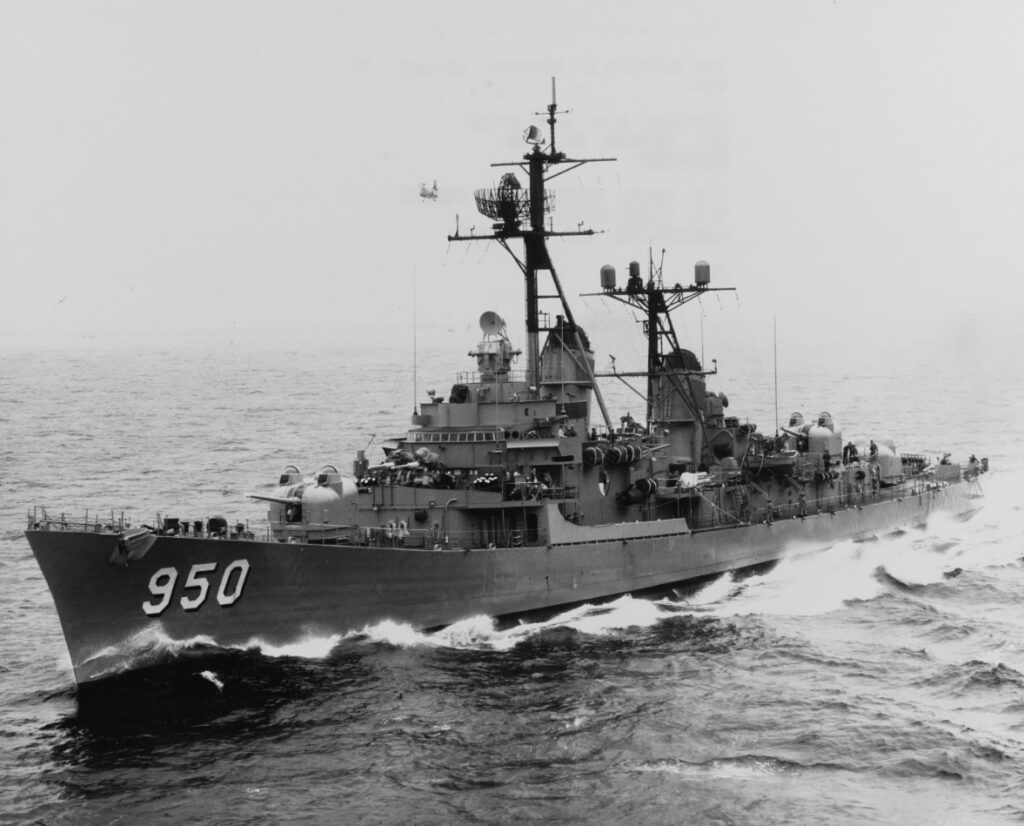
Throughout September and October 1962, the crew of the Richard S. Edwards trained at sea and in port for the ship’s upcoming deployment to the Western Pacific Ocean. A real-world event intervened in October, when the crew was put on alert and told to be ready to get underway on short notice. Walter found out why on October 22, when President Kennedy announced the Soviet Union had deployed nuclear-armed ballistic missiles to Cuba. Although the Cuban Missile Crisis resolved by October 28 and Walter’s ship never had to get involved, the event put the stakes of the Cold War into perspective for Walter and everyone else in the United States.
The training evolutions the Richard S. Edwards conducted off the California coast gave Walter the chance to learn and practice basic officer seamanship skills. He began by standing watch on the ship’s bridge under the tutelage of the Officer of the Deck, or OOD, who was a more senior and experienced officer responsible for safely driving the ship at sea. Walter served as the Junior Officer of the Deck, or JOOD, taking in everything the OOD did. As JOOD, he also often served as the ship’s Conning Officer, giving orders for course changes to the Helmsman and speed changes to the Lee Helmsman, who then executed the orders. Walter proved a quick learner. Before he detached from the ship in June 1964, he had qualified as OOD, Underway, Independent Operations (i.e., when the ship was sailing on its own) and OOD, Underway, Fleet Operations (i.e., when the ship was sailing in the company of other Navy vessels).
Walter did not spend all his time on the bridge training when the ship was underway. To the contrary, he still had to perform his duties as ASW officer during the hours when he was not on watch on the bridge. Typically, he stood a four-hour bridge watch and then had eight hours off to do his other work or catch some sleep before he had to stand his next four-hour watch. However, to avoid watchstanders serving in the same four-hour time slots every day, the 4:00 p.m. to 8:00 p.m. watch was “dogged,” or broken into two sections: 4:00 p.m. to 6:00 p.m. and 6:00 p.m. to 8:00 p.m.[1] This resulted in Walter standing watch in every four-hour time slot over the course of forty-eight hours.
Buoyed by the four months of experience he now had under his belt, Walter deployed with the USS Richard S. Edwards on November 13, 1962, to the Western Pacific. Enroute, the ship stopped in Pearl Harbor, Hawaii. As the ship pulled into the harbor and sailed past the USS Arizona Memorial, Walter and the rest of the crew manned the ship’s rails and saluted their fallen comrades from World War II. Over sixty years later, the event still conjures a strong sense of pride, patriotism, and loss for Walter.
After rendering honors to the Arizona, the Richard S. Edwards tied up at a pier, allowing the crew to enjoy liberty ashore. Walter and another officer rented a jeep and drove around the perimeter of Oahu, taking in the island’s natural beauty. Then it was back to the ship and on to the next port of call: Naval Base Yokosuka, Japan.
The 4,000-mile voyage from Pearl Harbor to Yokosuka gave Walter the opportunity to stand lots of JOOD watches and practice his seamanship skills. Once the ship arrived in Japan, Walter visited Tokyo with some of the other officers. They took the opportunity to enjoy a drink at the world-famous Imperial Hotel designed by Frank Lloyd Wright and tour outside the Imperial Palace where Emperor Hirohito lived.
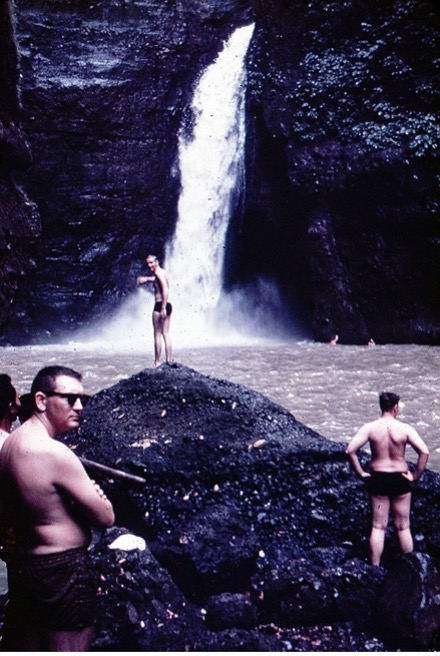
Reprovisioned and refueled, the Richard S. Edwards departed Yokosuka and joined with the aircraft carrier USS Ranger (CVA-61) and its other escorts to form a battle group. After conducting maneuvers at sea, the group sailed to Naval Base Subic Bay in the Philippines. There, Walter showcased one of his other responsibilities—the ship’s Welfare and Recreation officer. His job was to plan recreational activities for the crew that might entice them away from the women and alcohol readily available in the many bars just outside the main gate in Olongapo. He arranged a trip to Pagsanjan Falls, a picturesque waterfall located about sixty miles southeast of Manila. The participants bused to a location upstream and then rode in canoes to the falls. Once there, they enjoyed swimming for the day. As the port visit neared its end, Walter arranged a picnic for the entire crew, featuring sports, hotdogs and hamburgers, and beer. The events refreshed the crew and prepared them for the many days at sea that lay ahead.
After Subic Bay, the Richard S. Edwards sailed together with the other ships in the USS Ranger battle group. The ship had two primary duties: protect the Ranger from hostile submarines and serve as plane guard when the Ranger conducted flight operations. As the ASW officer, Walter and his Fox Division were front and center when it came to addressing the submarine threat. They swept the ocean’s depths with the ship’s sonar to detect any hostile submarines that might be lurking nearby. Plane guard duties required a different skill set, with the Richard S. Edwards positioning itself astern of the Ranger in case one of the carrier’s planes crashed at sea. When it was plane guard, the Richard S. Edwards would race to the location of the downed aircrew to rescue them before they were lost.
After operating with the Ranger and her other escorts for several weeks, Walter and the Richard S. Edwards made a port call in Sasebo, Japan and visited nearby Nagasaki—the site of the second atomic bomb attack during World War II. By the time Walter visited, the city had been largely rebuilt and there was little to recall the total devastation inflicted by the attack.
From Sasebo, the Richard S. Edwards returned to operating with the Ranger battle group after a brief stop in Yokosuka. Again, the ship’s focus was on its ASW and plane guard duties. During this period, one of the Ranger’s planes did crash at sea, and the Richard S. Edwards sped to rescue the pilot. Unfortunately, by the time the ship arrived at the crash location, all that remained was an oil slick and debris floating where the plane had vanished beneath the waves.
Another event that stands out for Walter occurred when the ships in the Ranger battle group, sailing in a circular formation, merged at high speed with a group of replenishment ships sailing in their own circular formation. The result was a very large circular formation that included all the ships from both groups. Each ship in the Ranger battle group then took its turn refueling and taking on stores from the replenishment ships. Walter was in awe of the seamanship it took to execute such a complex maneuver, where mistakes could mean collisions and the loss of life. Yet all the ships participating in the maneuver executed it flawlessly.
The Richard S. Edwards next visited the port of Kaohsiung on the southwestern coast of Taiwan. After taking on fuel and stores, the ship headed out to sea, this time to patrol the Taiwan Strait. The strait, which lies between Taiwan and Mainland China, has always been contested waters, with the United States and most of the world considering the strait international waters and China claiming it is not. The patrol proved uneventful, although the strait’s waters were shallow, rough, and crowded with fishing vessels and their nets, making the crew happy when the mission ended.
In late March 1963, the Richard S. Edwards pulled into Keelung on the northeast coast of Taiwan. As the port was only about twenty miles northeast of Taipei, Taiwan’s capital, Walter visited the city. When it came time for the ship to depart, a large Conex box was craned onto the deck of the ship. Four or five men who looked like Marines manned the box, which had antennas protruding from its roof. Carrying this curious cargo, the ship proceeded across the South China Sea and into the Gulf of Tonkin. Once there, it sailed southward twelve miles off the coast of North Vietnam until it reached the demilitarized zone between North and South Vietnam. The ship then turned around and retraced its path, at one point encountering a North Vietnamese gunboat. Eventually, the Richard S. Edwards withdrew without incident. It then returned to Keelung to unload the Conex box and drop off the Marines before sailing to Hong Kong for a week-long visit. Although Walter did not know it at the time, the mission to the Gulf of Tonkin was one of a series of Top Secret missions known as Desoto Patrols, which collected signals intelligence from North Vietnam and China.[2]
After saying goodbye to Taiwan, Walter and the Richard S. Edwards made one final stop in Yokosuka before starting the long trek home to San Diego. They sailed on the way back with the Ranger and the other ships from her defensive screen. To shorten the distance home, the ships took a great circle route, sailing along the Kamchatka Peninsula before crossing the Northern Pacific south of Alaska and cruising along the West Coast of the United States to Southern California.
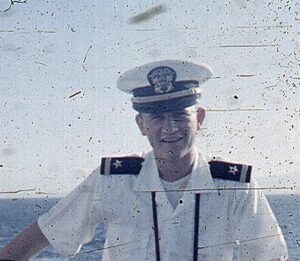
One day while sailing east of the Kamchatka Peninsula, Walter sighted an incoming plane while standing watch on the bridge. When he realized it was likely a large Soviet bomber, he informed the captain, who confirmed his suspicions. The captain ordered the ship to general quarters and instructed the 5-inch gun crews not to activate their gun mounts because he was afraid the sudden power requirements would overload the ship’s generators. Unfortunately, the gunners did as they had been trained to do rather than as the captain ordered, and they began to move the gun mounts to ready them for action. As the captain feared, this proved too much for the ship’s generators and the guns lost power just as they were aimed at the Soviet bomber. The captain was furious, not only because his ship was now defenseless until another generator could be brought online, but also because he did not want to provoke the Soviet bomber. It all proved for naught, though, because as the Soviet bomber got closer, Walter could see it had already been intercepted by two jet fighters from the USS Ranger. Still, the captain let the gunners know in no uncertain terms that he was not pleased with their performance.
A more violent event occurred when a typhoon overtook the battle group as it crossed the Pacific. The seas battered the Richard S. Edwards, causing it to roll forty-five degrees to port and starboard for twelve long hours. Had the ship rolled just seven more degrees to either side, it would have risked taking water down the stack and foundering. Walter had to place one foot on the deck and the other on a bulkhead just to stand upright. Although he did not get seasick, he felt bad—all he had to eat during the three-day storm was an apple and some saltine crackers. Many crewmembers were even more affected by the rough seas, making it hard for them to work and impossible for them to hold down food.
The Richard S. Edwards finally returned to Naval Station San Diego on June 15, 1963. The crew had been away from home for seven months and now enjoyed some well-deserved time with their families. Once they returned to work, they again began training on the ship off the coast of Southern California. Although the crew was briefly put on alert when President John F. Kennedy was assassinated on November 22, 1963, it remained focused on preparing for the ship’s next deployment scheduled for August 1964. Walter, who had promoted to lieutenant junior grade in December 1963, would not go on that deployment because his two-year active-duty commitment ended the month before the ship would depart. Accordingly, he was released from the ship at the end of June and on July 5, 1964, returned to Boston as a civilian, although he remained part of the Navy’s Individual Ready Reserve (IRR) per the ROTC contract he signed at Tufts. He subsequently promoted to lieutenant while on the IRR roster. He received his honorable discharge from the Navy Reserve in 1968.
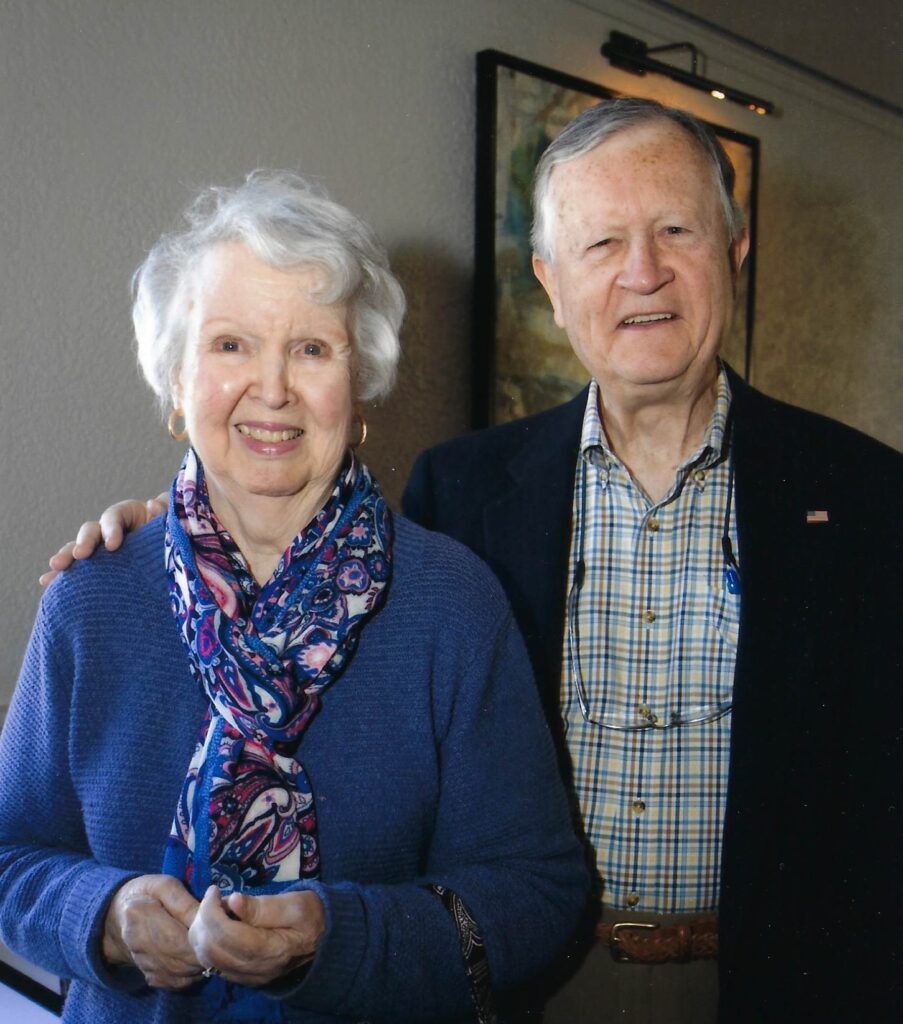
Once back in Boston, Walter worked as a project engineer for the Badger Company, a major engineering and construction firm. In November 1965, he married his sweetheart, Barbara Byrne, whom he had dated for seven years. The couple eventually purchased a house in Norfolk, Massachusetts, and started a family. Walter remained with the Badger Company for four years before earning his master’s degree in engineering management and taking a position with the Polaroid Corporation. He worked at Polaroid for thirty-three years, formally retiring in 2002. Since then, he and Barbara have enjoyed spending time with their three children and six grandchildren. Walter has also participated in several reunions of the Richard S. Edwards’ crew, giving him the opportunity to swap sea stories with his former shipmates. (As an old chief once told Walter, “All sea stories are true, and some of them even happened.”)
Voices to Veterans is proud to salute Lieutenant Walter Byron, U.S. Navy, for his distinguished service onboard the USS Richard S. Edwards. In addition to participating in ROTC at Tufts University, Walter served for two years on active duty, deploying to the Western Pacific to protect U.S. interests and allies. We thank Walter for his service and wish him fair winds and following seas.
If you enjoyed Walter’s story, please sign up for the Voices to Veterans Spotlight monthly newsletter by clicking here. Once each month, you’ll receive a new written veteran’s story directly in your mailbox. Best of all, it’s free and you can unsubscribe at any time.
[1] The shortened watches are known as “dog watches” because they are curtailed, possibly as a play on the word cur, which is an archaic term for a dog.
[2] To learn more about USS Richard S. Edwards’ Desoto Patrol, including its encounter with a North Vietnamese gunboat, see Joseph Wozniak, “Gulf of Tonkin, North Vietnam Desoto Patrol,” The Tin Can Sailor, Summer 2024, 4–6.