ET3 James A. Luteran, U.S. Navy – Enjoying the Ride on the USS Grouper (SSK-214)
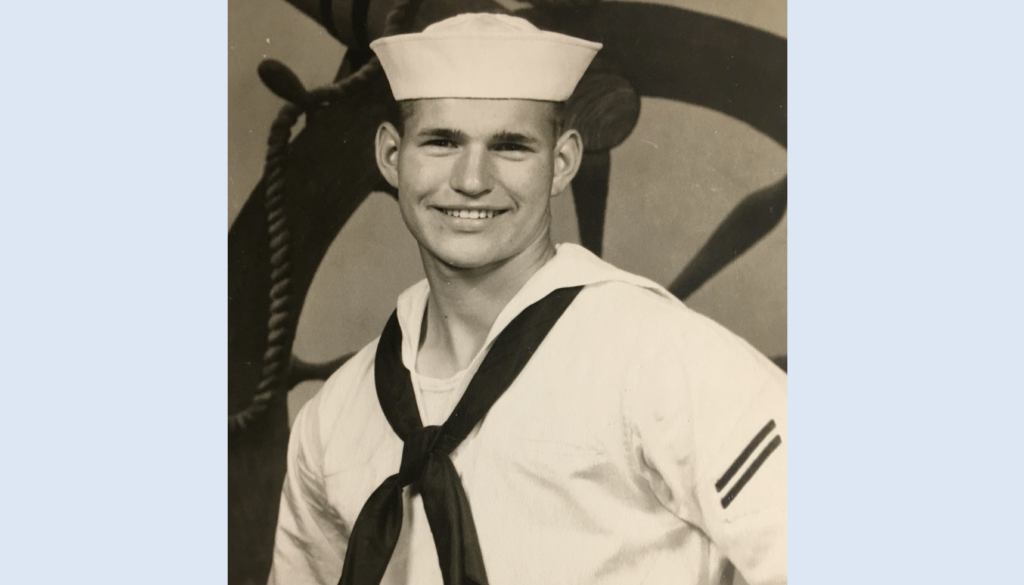
Oftentimes, military service is a steppingstone to bigger and better things. It matures young men and women, augmenting their youthful enthusiasm and energy with hard-earned self-confidence, personal discipline, and leadership skills. The military develops these traits in servicemembers through rigorous training and real-world tests. Electronics Technician 3rd Class James A. Luteran, U.S. Navy, overcame all the challenges that duty on a diesel submarine in the late 1950s sent his way. He emerged proud of his Navy service and ready for a life of inspiring others as an educator.
Jim was born in Youngstown, Ohio, in March 1938. His father worked for the Hood Electric Company, which distributed electrical equipment and did electrical contracting for customers, while his mother worked at home raising Jim and his older sister. He attended Youngstown’s Rayen High School, where he played linebacker and center on the school’s undefeated football team during his senior year. He also played catcher for an American Legion baseball team because Rayen didn’t have its own team. After sports practice and on weekends, he worked at an Italian food store stocking shelves.
Jim graduated from Rayen High School in June 1955, shortly after he turned seventeen. Like his father, he took a job with the Hood Electric Company. The job gave him the chance to earn some money and figure out what he wanted to do with his life now that he was out of school. He thought about college, but what he really wanted to do was join the Navy because an uncle he admired served in the Navy during World War II. Jim was also enthralled by submarines and thought if he could serve on one, that would really be fun. A hitch in the Navy might also allow him to save some money for college.
To check out his options, Jim visited a Navy recruiter who told him about the “Kiddie Cruise” program, which seemed too good of an opportunity to pass up. Under the program, if Jim enlisted while he was still seventeen, he would only have to obligate for three years of active duty instead of the usual four. That meant he would be discharged and ready to start college or civilian work before he turned twenty-one.
There was, however, one rub. Jim really wanted the Navy to train him as an electronics technician because he thought that might give him the best chance of being assigned to a submarine. To get that job, or rating in Navy terminology, Jim needed to have taken algebra in high school—which he had not. Not to be deterred, he enrolled in algebra night school classes and passed, paving the way for his electronics technician training once he joined the Navy.
With his plans set, Jim signed the enlistment papers on the day before his eighteenth birthday. As required by his contract, he reported for boot camp at the U.S. Naval Training Center in Bainbridge, Maryland, on July 23, 1956. There his daily routine started with reveille at 6:00 a.m. and mopping the floor. Then he showered, got dressed, and stood for inspection. Once his company commander determined everyone looked shipshape, they marched to the mess hall for breakfast. They ate in cadence, giving new meaning to eating together. From there, they marched to classroom instruction and physical fitness activities, all the time learning about Navy customs and traditions and building esprit de corps.
Jim made it a point to keep out of trouble and do his best at whatever his instructors told him to do. As for the physical training, since he was already in great shape from having played football and baseball in high school, it was easy for him. His company commander recognized his efforts and leadership potential and picked him to be a squad leader—a position at which he excelled primarily because of the strength of his personal example.
Jim graduated from the nine-week boot camp in September 1956. He immediately rolled into Electrical & Environmental Preparatory School (E&E “P” School), also in Bainbridge, to help prepare him for his follow-on training as an electronics technician. E&E “P” School introduced Jim to electricity fundamentals and ship environmental systems like air conditioning and refrigeration, taught him how to read blueprints, and instructed him how to safely work with tools on high-voltage equipment.
After graduating from E&E “P” School on November 9, 1956, Jim made his way to Electronics Technician “A” School at Naval Training Center Great Lakes. His training began by delving into electricity more deeply, including learning about vacuum tubes and solving complex algebraic equations about resistance and AC current. Jim soon realized there was no way he could have succeeded in the training without having completed his night school classes in algebra prior to his enlistment.
Over Christmas leave at home in Youngstown in December 1956, Jim put what he was learning at “A” School to the test. After reading a Popular Mechanics magazine article about how to build a radio transmitter, he went to an electronics store and bought all the parts. He then built a radio transmitter from scratch. To try it out, he took it to an upstairs room while his young nephew sat by the downstairs radio. Pretending to be Santa Claus, Jim used his transmitter to broadcast over the radio to his nephew. For the next half hour, his nephew told the radio he had been a good boy and listed what he wanted for Christmas. At that point, Jim knew his training at Electronics Technician “A” School was doing its job.
Jim returned to Naval Training Center Great Lakes after Christmas leave to complete his training. While there, the opportunity he had been waiting for materialized. The submarine community needed electronics technicians so Jim put in an application to go to Submarine School in New London, Connecticut. He was accepted into the program and, after completing Electronics Technician “A” School on January 18, 1957, transferred to New London.
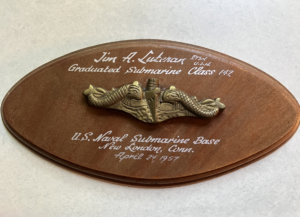
Jim began Submarine School on March 4, 1957. Two aspects of this training stood in the way of him realizing his goal of being assigned to a submarine. One was the pressure test, where he had to sit in a small compartment with other sailors while the pressure in the room was gradually increased and then decreased back to sea level. Jim had no problem while the pressure increased. However, as the controllers began to return the pressure to sea level, Jim’s ears would not pop and equalize the pressure. When he thought he could take it no more, he informed the controllers of his plight. They told him to hang on because they were almost finished. Unfortunately, in the small amount of time left, Jim’s eardrum burst. Although it felt good at the time because the pressure in his ears finally equalized, the blood in his ear told him and his controllers something was wrong. They sent him to the hospital, where they repaired the damage to his ear, and he was permitted to continue with the training. It was a close call that impacted his hearing for the rest of his life.
The second challenging aspect of the training involved the notorious water tower. To pass this test, Jim had to leave a compartment at the bottom of a 100-foot water tower and make it to the surface safely. The instructors told him the key to success was to exhale as he rose through the water column—otherwise, the air in his lungs would expand from the decreasing pressure until they blew up, and he would die.
Before attempting the 100-foot ascent, the instructors took Jim to a compartment twenty-five feet from the top of the tower to let him practice exhaling to the top. When he was released into the tower, he made it to the surface without any problems. Then he was taken to the fifty-foot level for a second practice run. This time, he had to wear a life vest which would help bring him to the surface fifty feet above. Again, he went into the tower and started to ascend, exhaling as he did. About halfway to the surface, a frogman in the tower punched him in the stomach and all his air came out. When Jim reached the surface, he asked the frogman why he had hit him so hard. The frogman replied that Jim was not exhaling enough air, so he had to quickly get the excess air out of Jim’s lungs. The incident had the desired effect because when Jim did the third ascent from 100 feet, he exhaled fully all the way to the surface and passed the water tower test with flying colors.
The pressure test and the water tower test weren’t the only things Jim had to pass at Submarine School. He also had to learn about the major systems on a diesel submarine and master basic damage control techniques. He spent hours studying classroom lectures and took written psychological tests to predict whether he was well-suited for submarine duty. He passed everything and graduated from the two-month school on April 24, 1957.
Jim had one final training course to complete—the Electronics Technician Submarine course. This course, which was taught in New London, trained Jim on the highly classified submarine electronics systems he would be working on once he reported to his first submarine, or “boat” in submariner parlance. These systems included radar, sonar, and LORAN (long-range aid to navigation) equipment, all adapted specifically for use on board submarines. Jim completed the training on May 17, 1957, feeling well-prepared for his first operational Navy assignment.
That assignment turned out to be the USS Grouper (SSK-214), a World War II-era Gato class submarine modified in the early 1950s by adding a snorkel for enhanced underwater operations and state-of-the-art sonar and radar.[1] When Jim went aboard for the first time and walked through the boat, he saw all the valves and systems crammed into the hull and thought, “How am I ever going to learn all this?” He was assigned a rack in the middle of a stack of three so close to one another that he couldn’t turn sideways without hitting the rack of the sailor sleeping just above him. Even more worrisome, right next to him was one of the submarine’s giant torpedoes, reminding him he was on a warship armed to the teeth with lethal weapons.
Although Jim’s main job was maintaining his boat’s electronic systems inport and operating them when underway, he also needed to be familiar with every inch of the submarine to officially qualify as a submarine sailor. In fact, not only did he have to memorize every valve on the submarine and what it did in case of an emergency, but he also had to draw each of the submarine’s systems—including its electrical, environmental, damage control, and plumbing systems—and submit the drawings for evaluation to demonstrate he knew where everything on the submarine was. Each week he took a test to document his progress.
At the end of six months of crawling around the submarine to make sure he knew it like the back of his hand, Jim had to stand before a board of officers and chief petty officers and answer technical questions about the Grouper and its operations. The stakes were high because he knew if he didn’t pass, he’d be transferred off the submarine “to wash dishes on a destroyer.” To keep that from happening, he spent every free minute he had studying for the exam. After Jim passed, the Grouper’s captain pinned the dolphins badge on Jim’s chest at a ceremony on the deck before the boat’s assembled crew. The dolphins badge announced to everyone that Jim was now a qualified submarine sailor. It was one of the proudest days of his life.
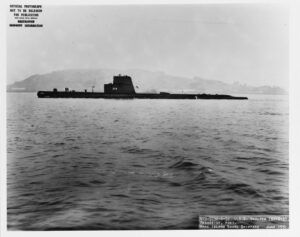
When the Grouper was underway, Jim not only maintained the submarine’s electronic equipment, but he also operated it. He learned to raise the submarine’s radar antenna and rotate it above the submerged submarine searching for any nearby aircraft or surface ships. When he identified a contact, he used a cursor to measure the distance and bearing relative to the submarine.
Similarly, Jim learned how to operate the Grouper’s BQR4 sonar system. The system was so sensitive, Jim could hear the hum of passing cowfish and the clicking sound made by schools of shrimp snapping their claws. It was said that trained operators on the Grouper like “Sam the Sonarman” could hear “a fish fart at forty miles.” Sam was even able to discern what type of ship the sonar had found by the sounds from the ship’s screws (i.e., propellors). Once Sam determined the distance, bearing, course, and speed of the surface contact, the data could be fed into the Grouper’s torpedo data computer to calculate an attack solution, if necessary.
When the Grouper headed to Europe on September 1, 1957, for a series of exercises with NATO and the UK,[2] Jim got to see just how skilled Sam was. During Event Snapper of Exercise Pipedown, the Grouper’s mission was to penetrate a screen of destroyers and run simulated torpedo attacks against high value targets. On the afternoon of October 14, the Grouper got its chance when it came to periscope depth and sighted one of the carrier’s escorts.[3] It conducted a simulated attack on the escort, documenting it had done so by firing green flares in the escort’s direction. Still submerged and using its periscope, the Grouper then sighted the aircraft carrier—its ultimate objective.
After maneuvering below the surface, the Grouper’s captain gave the order to take the submarine up to look around. Sam replied, “Captain, there are screws up ahead.” The captain repeated his order to take the Grouper up, and Sam again said, “Captain there are screws up ahead.” The captain repeated his order yet again and the crew did as instructed. Moments later, the submarine shuddered from stem to stern. Jim, who was at the sonar desk with Sam, heard a boom. Then a call came over the underwater telephone, which could transmit voice communications through the water, from the USS Haynsworth (DD-700): “I think I hit you. Surface immediately.”
The Grouper’s captain, who likely had visions of the collision ending his career, replied, “We are okay.” The Haynsworth then ordered the Grouper’s captain to surface to inspect the damage. When the Grouper did, the crew found the submarine’s snorkel head valve housing had been “dented, warped, and torn.” The Haynsworth sustained no apparent damage and no one on either vessel was injured.[4]
While many of the old salts on the Grouper described the collision as the most terrifying event of their careers since the boat easily could have sunk, Jim was so new, he did not appreciate the danger. In fact, he found the whole episode exciting. After the collision, the Grouper sailed back to Naval Base New London, remaining on the surface for the entire voyage. It arrived safely on October 23, 1957.[5]
Jim promoted to electronics technician third class on December 1, 1957, which recognized both the experience he’d gained over the past year and his passing of an advancement exam. For the next sixteen months, he put his experience to the test at sea while the Grouper exercised and patrolled off the east coast of North America. During that time, the Grouper patrolled from Halifax to the Caribbean, enhancing the crew’s warfighting skills through training and exercises. At the same time, the crew kept a watchful eye out for any Soviet ships or submarines that might venture into the North and Western Atlantic.
During one such patrol into the North Atlantic, Jim had a harrowing experience he will never forget. On April 24, 1958, he was manning the radar when the Grouper was at periscope depth. After Jim swept the horizon with the submarine’s radar, the captain ordered “lower periscope.” Just as Jim hit the button to execute the order, a wave hit the submarine causing it to roll. Jim lost his balance and placed his foot over the hole in the deck where the bottom of the periscope tried to lower into, crushing his boot.[6] He was able to pull his foot free, but it really hurt, so he sat down and took off his boot to see if his foot was okay. In the interior dim red light of the control space, he could see nothing but thought it odd his foot had somehow gotten wet. He put his boot back on, but when he couldn’t walk, he asked for help and was taken to a table in the mess so the sub’s corpsman—a yeoman who had received emergency first aid training—could examine his injury.
When the corpsman took off Jim’s boot, blood poured out. He said, “Oh no, Jim. Your big toe is off. I am going to have to sew it back on.” He gave Jim a shot to help with the pain, but even that hurt like hell. The corpsman stitched Jim’s big toe back in place and then made a cast to protect it until it healed. Jim was initially told to rest in his rack, but his foot hurt so badly that it made sleeping difficult. He also couldn’t walk to the head to relieve himself, so he had to urinate in a jar and hand it to any sailors passing by to empty it for him. Soon, sailors avoided walking past him. Eventually, he was able to return to his duties.
By May 10, Jim knew he was in trouble because his toe had developed gangrene. The problem was that the submarine was still in the middle of the North Atlantic. In an amazing display of precision navigation, an Air Force helicopter from Iceland rendezvoused with the Grouper at sea.[7] The helicopter then lowered a stretcher basket to the surfaced submarine and Jim climbed in before being winched up to the hovering helicopter. It then flew him to the hospital at Naval Air Station Keflavik, where a Navy doctor amputated his toe. Once he was well enough to travel, he returned to New London and rejoined the Grouper. He resumed his duties as if nothing had happened.
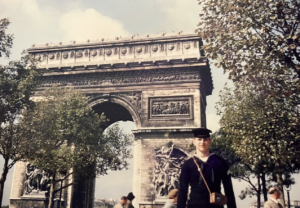
In addition to the many challenges Jim faced at sea, he got to enjoy some fun port visits, including Halifax, Bermuda, Fort Lauderdale, Key West, and other U.S. ports in between. For example, after the Grouper participated in NATO’s Exercise Strikeback in Europe in September 1957, it made a port call in Le Havre, France.[8] While there, Jim and some of his shipmates went to a restaurant owned by an older French woman who spoke no English. When shore patrol came around to start sending sailors back to their ships, the French woman turned out the lights at the restaurant and allowed the submariners to eat and drink late into the evening. The woman treated Jim and his friends as if they were her sons, and they had a wonderful time.
A few days later in Portland, England, Jim went ashore and met a British girl. She took him home to meet her mother and have dinner. To get there, they rode a double-decker bus to an area outside of the city. When they arrived, Jim was astonished to see that the house still had a thatched roof. The girl’s mother rolled out the red carpet, cooking a feast for Jim. He could not believe how welcoming they were to an American sailor.
In February 1958, Jim got to visit Havana, Cuba,[9] which at the time was still under the control of a military dictator, Fulgencio Batista.[10] While there, he purchased a case of Canadian Club whisky and a gallon of rum for a ridiculously low price. The distributor shipped his order and those of his shipmates to New York City. Once the Grouper returned to New London, a truck was sent to New York City to pick up everyone’s orders. Much to Jim’s mother’s dismay, he gave the case of Canadian Club to his father, who enjoyed it a little more than his mother would have liked.
Above all, Jim loved the experience of being at sea and working with his shipmates. An event that occurred when the Grouper was “dipsy-doodling”—repeatedly diving and surfacing to practice the procedures—summed up his feelings. As he looked through the periscope, he saw what he estimated to be a 500-pound sea turtle sitting on the submarine’s deck and enjoying the ride. That was exactly what Jim was doing on the Grouper—enjoying the ride.
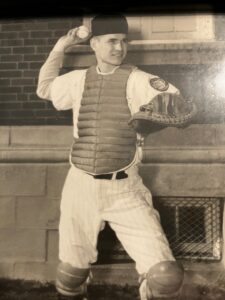
Jim remained onboard the Grouper until his discharge in March 1959. He returned to Ohio and enrolled at Mount Union College, a small liberal arts school located midway between Cleveland and Pittsburgh in Alliance, Ohio. Despite the injury to his foot in the Navy, he made the football and baseball teams, leading to a life-changing experience. Because he had no money, the football coach arranged for him to serve as the recreation director for the nearby Fairmont Children’s Orphanage. There, he found his calling.
Every day after football practice, Jim took the kids out to play softball or drove them on a bus to lots of fun activities. He loved working with the kids, and they loved him, too, with the youngest ones clinging to him whenever he was around. He worked there all four years and lived and ate there during his sophomore, junior, and senior years.
Working with the kids gave Jim’s life direction and helped him pay for college. As he still needed to earn spending money, he also worked at a drugstore and a funeral home, taking calls and picking up bodies. Whenever there were college dances, he bought out the local florists and resold the flowers to the college’s fraternities.
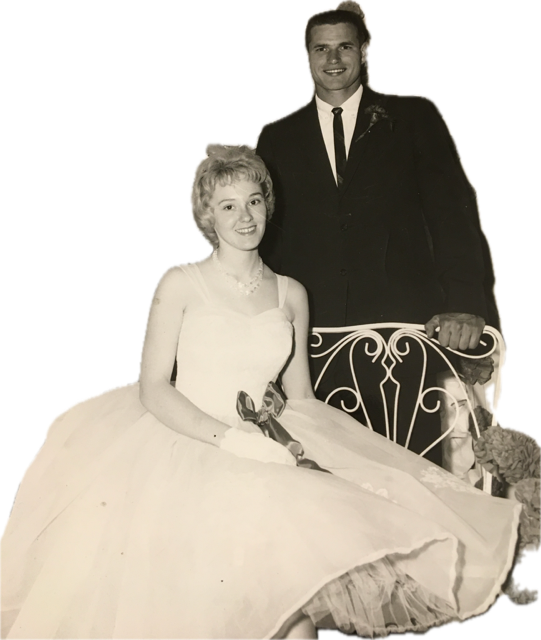
Working at the orphanage was not the only life-changing experience Jim had at Mount Union. During his sophomore year, he met Marilyn Van Deusen, who was a year behind him. They were married on June 20, 1964, soon after Marilyn graduated from Mount Union.
By that time, Jim was already hard at work at his first job teaching science at Walnut Middle School in Painesville, Ohio. While there, he attended night classes and earned his master’s degree in education administration and counseling at John Carroll University. With that degree in hand, he took a new position as the assistant principal at Painesville’s Thomas W. Harvey High School.
In 1972, Jim accepted a position as the principal of Olmsted Falls High School in southwest Cuyahoga County, Ohio. He remained in that position for twenty-one years until he took a teaching job at Ursuline College in Pepper Pike, another Cleveland suburb. He left Ursuline and became the director of the Polaris Career Center—a high school offering technical career training for juniors and seniors in the surrounding communities, ran technology in the classroom workshops for WVIZ TV in Cleveland for ten years, and finally retired in 2010 after working with student teachers studying at Cleveland State University.
Jim and Marilyn are now enjoying retirement in Olmsted Falls, Ohio, where all three of their children—Jimmy, Kerri, and Jared—attended high school while Jim was principal. They love spending time with their kids and their families, which now form a large and close Luteran clan. In fact, Jim and Marilyn’s extended family now includes eleven grandchildren and eight great-grandchildren.
Voices to Veterans is proud to salute Electronics Technician 3rd Class James A. Luteran, U.S. Navy. Through hard work and a commitment to serve, he made his dream of serving on a U.S. Navy submarine come true. He then patrolled with the USS Grouper on both sides of the Atlantic, overcoming the many dangers of life at sea. After serving with distinction, he went on to a forty-five-year career in education, exemplifying honor, courage, and commitment for countless young men and women. We thank Jim for all he has done and wish him fair winds and following seas.
If you enjoyed Jim’s story, please sign up for the Voices to Veterans Spotlight monthly newsletter by clicking here. Once each month, you’ll receive a new written veteran’s story directly in your mailbox. Best of all, it’s free and you can unsubscribe at any time.
[1] The USS Grouper was commissioned on February 12, 1942. The submarine completed nine war patrols in the Pacific Campaign during World War II. “USS Grouper,” Wikipedia, last modified May 21, 2026, https://en.wikipedia.org/wiki/USS_Grouper.
[2] Deck Log, USS Grouper (SSK-214), entry for 1 September 1957, image 5, National Archives Identifier 217294626, Record Group 24: Records of the Bureau of Naval Personnel, National Archives Catalog, https://catalog.archives.gov/id/217294626?objectPage=5.
[3] Deck Log, USS Grouper (SSK-214), entry for 14 October 1957, image 31, National Archives Identifier 217294708, Record Group 24: Records of the Bureau of Naval Personnel, National Archives Catalog, https://catalog.archives.gov/id/217294708?objectPage=31.
[4] Deck Log, USS Grouper (SSK-214), entry for 14 October 1957, image 33, National Archives Identifier 217294708, Record Group 24: Records of the Bureau of Naval Personnel, National Archives Catalog, https://catalog.archives.gov/id/217294708?objectPage=33.
[5] Deck Log, USS Grouper (SSK-214), entry for 23 October 1957, image 51, National Archives Identifier 217294708, Record Group 24: Records of the Bureau of Naval Personnel, National Archives Catalog, https://catalog.archives.gov/id/217294708?objectPage=51.
[6] Deck Log, USS Grouper (SSK-214), entry for 24 April 1958, image 50, National Archives Identifier 217295124, Record Group 24: Records of the Bureau of Naval Personnel, National Archives Catalog, https://catalog.archives.gov/id/217295124?objectPage=50.
[7] Deck Log, USS Grouper (SSK-214), entry for 10 May 1958, image 23, National Archives Identifier 217295190, Record Group 24: Records of the Bureau of Naval Personnel, National Archives Catalog, https://catalog.archives.gov/id/217295190?objectPage=23.
[8] Deck Log, USS Grouper (SSK-214), entry for 30 September 1957, image 77, National Archives Identifier 217294626, Record Group 24: Records of the Bureau of Naval Personnel, National Archives Catalog, https://catalog.archives.gov/id/217294626?objectPage=77.
[9] See Deck Log, USS Grouper (SSK-214), entries for 7–10 February 1958, images 17 through 23, National Archives Identifier 217294988, Record Group 24: Records of the Bureau of Naval Personnel, National Archives Catalog, https://catalog.archives.gov/id/217294988?objectPage=17.
[10] “Fulgencio Batista,” Wikipedia, last modified March 18, 2026, https://en.wikipedia.org/wiki/Fulgencio_Batista.