Let’s help veterans tell their stories. I’m not talking about the generals or the admirals, or the national heroes who already have a platform to speak and be heard. I’m talking about the everyday Soldiers, Sailors, Airmen, Marines, and Coast Guardsmen who were drafted or volunteered and did their duty day in and day out. Maybe they worked in the mess halls serving chow, or helped load ordnance onto jets waiting their turn to launch on combat missions, or maybe they had to watch their friends get hit in an ambush or a firefight in a rice paddy in Vietnam.
We can work together to get these veterans’ stories told. If you are a veteran, or you know a veteran you’d like to have considered, send me the story. I’ll then select veterans from the nominations I receive and feature their stories in my monthly Voices to Veterans Spotlight. I’ll announce the stories on Facebook so you’ll know to visit my website and check them out.
 Here’s what I need from you – send an email to VoicesToVeterans@gmail.com with the name of the veteran and their contact information. You can also nominate yourself if you are a veteran. I will then reach out to the veteran and talk to them about sharing their story. There is no cost involved—the entire process is free.
Every veteran whose story I feature will receive a free signed copy of my Steve Stilwell legal thriller, Sapphire Pavilion, which is dedicated to “Wounded Warriors and Vietnam War veterans, especially those heroes still waiting to come home.”
This is a small step in honoring America’s veterans, but it’s a step we can take together.
Voices To Veterans Spotlight – September 2017
Staff Sergeant Vanessa Lawicki Vaché – Determination Has No Bounds
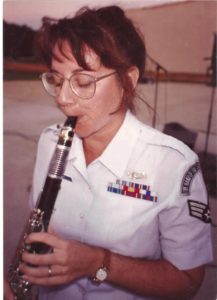 To understand Staff Sergeant Vanessa Lawicki Vaché, U.S. Air Force, you have to explore her roots. She grew up in Olmsted Falls, Ohio, a small town about 25 miles from downtown Cleveland. She played clarinet in her high school band and loved music. She wanted to go to Baldwin Wallace College, a local liberal arts college with a good music program, but her band director bluntly told her she wasn’t good enough. Worse yet, her guidance counselors told her she wasn’t smart enough to go to college. With her grades, they said, she would never get in.
What the band director, the guidance counselors, and even Vanessa didn’t know, was that Vanessa had Dyslexia, which made high school incredibly difficult for her. But what Vanessa did know was that she loved music, so she set out to prove the naysayers wrong.
Vanessa practiced her clarinet incessantly, auditioned for Baldwin Wallace College, and was accepted for admission. She spent one year there after she graduated from high school in 1977, practicing a minimum of four hours a day in addition to her music classes and band performances. She also took lessons from a clarinet player in the Cleveland Orchestra, who gave her the confidence she needed to succeed. But all of this cost money, and Vanessa’s family didn’t have much. So she worked at a pizza parlor whenever she could and earned just enough money to pay her way through school.
One year later, Vanessa auditioned for and was accepted into the prestigious Manhattan School of Music, and her life changed. Suddenly, she was no longer the girl in high school struggling to get by. Now, she was the young woman respected for her musical ability and for who she was. Needless to say, living in Manhattan was expensive, so Vanessa took cleaning and waitress jobs – anything that would pay the rent. Recognizing Vanessa’s determination and talent, her teachers did everything they could to help her succeed. She did, graduating in four years with a Bachelors degree in music.
While that alone would be an amazing story, Vanessa didn’t stop there. She auditioned for and was accepted by the world-renowned Juilliard School, also in Manhattan. She studied and played clarinet at Juilliard for two years, graduating with a Masters degree in music. No one told her she wasn’t good enough now!
After Juilliard, Vanessa received an offer to play for the National Symphony of the Dominican Republic, so she moved to Santo Domingo in 1984. She was the Symphony’s principal clarinetist and stayed two years until the living conditions eventually got to her. The lights in her apartment went out routinely, the running water was undependable, and she was constantly sick from bad water and bad vegetables. So she returned to Cleveland to come up with her next move.
Wanting to play music and looking for a challenge, Vanessa auditioned for the U.S. Air Force music program. She was accepted and enlisted in the Air Force. In July 1987, she attended Basic Training at Lackland Air Force Base in San Antonio, just like any other Air Force recruit.
After six weeks of Basic Training, Vanessa graduated as an Airman (E-3). She then reported to the 541st Air Force Band at Pease Air Force Base in New Hampshire, where she played clarinet. She spent two and a half years there, but then volunteered to transfer to Europe in return for an informal guarantee that she would get to choose her return orders stateside.
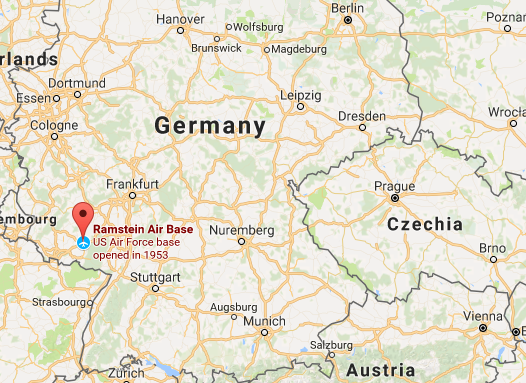 Vanessa’s timing was flawless. She transferred to the 686th Air Force Band, known as the U.S. Air Force Band Europe, just outside of Ramstein Air Base in West Germany one week after the Berlin wall fell. As if overnight, the Iron Curtain lifted and the Air Force Band was in demand in all of the newly liberated countries in Eastern Europe.
Everyone in the band was excited to see Eastern Europe, but they didn’t know what to expect. During Vanessa’s first trip east, her bus passed empty watchtowers looming over the borders. As the band drove closer to the towns, the world faded into a black and white picture from the 1940s. The landscape was dark and dreary, and every structure was old and needed paint. There were bombed out buildings from WWII everywhere, still with broken windows, walls without roofs, and piles of concrete all around. The air hung heavy with pollution, and even the sky stayed gray.
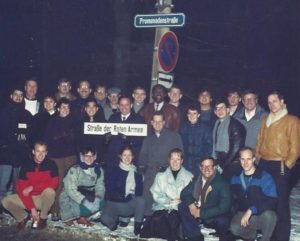 Vanessa played clarinet in the 60-piece Air Force Europe concert band. One of her first concerts was in Gorlitz, East Germany, near the border with Poland. The people were friendly, but very poor. They wanted to show hospitality to the band, but had no money or means to do so. They served the band soup, but there was barely anything in it. When some members of the band asked about Red Army Street, the town took down the sign and gave it to the band. Vanessa said this trip and others into the former Soviet Block revealed the realities of communism to her. Before it had been just another form of government she studied in school and heard about in the news. Now she saw first hand how people living under communist rule had to struggle to get by.
Vanessa’s most memorable concert was in the city of Pilsen in the Czech Republic. She and the rest of the musicians were loaded into buses outside of Ramstein and, contrary to their usual practice, drove through the night to get there. Vanessa managed to eke out a little sleep along the way, but woke up when her bus arrived in Pilsen.
When she looked outside, she couldn’t believe her eyes. American flags were everywhere! They hung from balconies and out of windows, they flew from flagpoles and the roofs of buildings, and thousands of people waiving small American flags crowded the area waiting for the band.
When the band members got out of the buses, the people from Pilsen swarmed them. They gave the band members hugs and flowers, but most of all they thanked them over and over. As the band marched to its first performance, a woman ran up to Vanessa and asked Vanessa to be in a picture with the woman’s baby. Vanessa gladly stopped and posed for the picture.
Vanessa learned later that Ambassador Shirley Temple Black arranged for the band to play for Pilsen’s Liberation Day, commemorating when Patton’s Third Army liberated the city from the Germans on May 6, 1945. The Russians liberated Prague (about 60 miles away) and the rest of Czechoslovakia, but after the Iron Curtain fell around the country, the Russians required the Czechs to teach that the Russians had liberated all of Czechoslovakia. The citizens of Pilsen never forgot, though, and made the truth part of their oral history.
 Vanessa and the Air Force Band were the first American service members to arrive in Pilsen since Patton’s Army left, so the people of Pilsen wanted to show them just how grateful they were to the United States.
Vanessa and the Air Force Band performed at numerous ceremonies over the course of the next two days. She and the others knew they were standing in for the heroes who liberated Pilsen at the end of World War II, and were glad they could play their part in linking the Czech and American people together once again. Pilsen made such a profound impact on Vanessa that she wrote a children’s book about it called The Big Thank You, which Vanessa illustrated herself.
Vanessa returned to the United States in 1992 and completed one more tour on active duty with the U.S. Air Force Reserve Band at Robbins Air Force Base in Georgia. The band traveled nonstop, and actually played concerts as far away as Turkey and Russia. The incessant travel eventually took its toll on her and after twelve years, Vanessa traded in her Air Force uniform for a more stable civilian life.
Vanessa lives with her husband and fellow jazz musician, Allan Vaché, in Florida, where she continues to play and teach music. She admits her Air Force experience came with costs, but she is proud to have served and feels it opened new doors for her. Her greatest takeaways, though, are the friendships she made with her fellow musicians and the many people she met and talked to before and after her performances across Europe. To Vanessa, the U.S. Air Force Band brought people together, one concert at a time.
Voices to Veterans Spotlight – August 2017
Sergeant First Class Herbert Burnett, U.S. Army – “Not On My Watch”
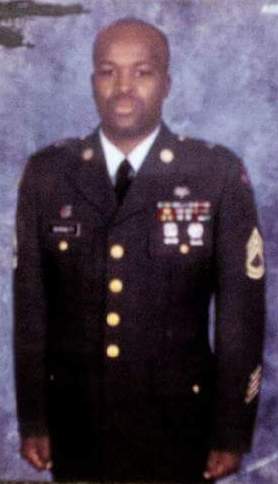 Sometimes when you meet a person, you can tell right away you are talking to someone larger than life. That’s the vibe you get from Sergeant First Class Herbert Burnett, U.S. Army (retired). He knows where he’s going and how to get there. Here’s his story.
Herbert is a native of Urbana, Illinois. He enlisted in the Army on March 26, 1986, to get away from the streets. His MOS (Military Occupational Specialty) was Medical Logistics, making him responsible for ordering, receiving, storing and issuing medical supplies. He practiced his skills in the Middle East twice – once in Saudi Arabia in 1992 after Operation Desert Storm, and later during the Iraq War in 2004.
Herbert deployed to Dharan, Saudi Arabia, in 1992, when he was a sergeant (E-5), although he was promoted to Sergeant First Class (E-6) shortly thereafter. His unit, the 21st Evac Hospital, was already there – he plugged into it once he arrived. He remembers the date he deployed with great clarity – 28 August 1992. That’s because his daughter was born two days after he left, on 30 August 1992. He didn’t get to see her until he returned from Saudi Arabia in December. Herbert stayed at Khobar Towers, near the King Abdulaziz Air Base. This was the same Khobar Towers that was destroyed by a terrorist bomb in 1996. By that time, Herbert had long since moved on to his next assignment.
After Herbert returned from Saudi Arabia, he was assigned to recruiting duty in Indianapolis, where he excelled. In fact, he was the Indianapolis Recruiting Battalion’s top recruiter in 1994 out of approximately 200 recruiters. This achievement earned him 3 years of follow-on recruiting duty in Champaign, Illinois, which is the sister city of his hometown, Urbana. But it was Herbert’s deployment to Iraq that proved to be the defining event of his long and successful Army career.
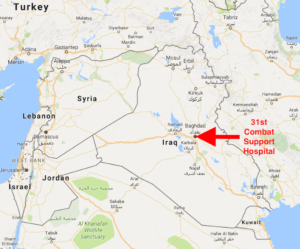
The Iraq War began in March 2003. Herbert’s unit, the 31st Combat Support Hospital out of Fort Bliss, Texas, deployed to Baghdad in January 2004. Herbert joined his unit in Iraq in April 2004. When he arrived, the unit – which operated a 296-bed hospital – was having serious medical logistics problems. No one was tracking orders, there was no good account of what supplies were on hand, and many supplies were left outside to bake in the hot Iraqi sun.
As a senior noncommissioned officer (NCO), Herbert set out to assess within 72 hours what was working and what was not, and what needed to be fixed right away. Working closely with a Lieutenant Colonel from his unit, Herbert developed a plan of attack to get the unit’s medical logistics operations squared away. Working sunup to sundown, he implemented the systems necessary to bring the logistics situation under control.
The turning point for Herbert’s soldiers occurred in June of 2004. Herbert started getting complaints from NCOs in the operating rooms and the emergency room (ER). They were asking for things and Herbert’s soldiers weren’t being responsive. Herbert contacted his counterpart in the ER and asked him to let Herbert know the moment he got word of any mass casualty situation. He didn’t have to wait long – the next day some seriously injured people were brought into the ER, including a female soldier who had a portion of her leg blown off and a deep cut in her thigh. Herbert mustered all of his soldiers, had them scrub up, and made every one of them observe the casualties so they could see that their fellow soldiers’ lives depended upon their actions. Herbert said that for the first time, his soldiers understood how important their jobs were. They had a “paradigm shift,” and were a different unit from that day forward. They excelled at what they did and were recognized for their performance and dedication to duty.
Over the course of his one-year tour in Iraq, Herbert was assigned four soldiers who had gotten into trouble in their units. Their units had given up on them, so they were assigned to Herbert to see if he could turn them around. One was a soldier who had gone AWOL and was close to being separated from the Army. Herbert worked with all four soldiers, devoting the necessary time and effort to help them succeed. He also gave them confidence by making sure they knew they were valuable members of his team. Herbert was particularly proud that all four of these soldiers completed their tours in Iraq and received awards for their performance – something unheard of for soldiers who had gotten into trouble. Even more impressive, the soldier who had gone AWOL turned out to be one of the best soldiers in Herbert’s unit, despite not having any prior medical logistics experience. Herbert proved that soldiers will follow leaders who lead them to success.
Herbert also served as a convoy commander, making dozens of runs between the Green Zone and Baghdad International Airport. This was particularly dangerous in 2004 because the Humvees they drove didn’t have the heavier protective armor that arrived later in the war. On one occasion, Herbert gave his convoy team some time to visit the Post Exchange. He told everyone to return to the vehicles by 4:45 p.m. because they needed to be back before nightfall. One member ran back to the Exchange to get a fifty-cent candy bar and was late getting back. As a result, the convoy didn’t depart until 5:10 p.m., and it was dark by 5:30 p.m. The convoy took and returned fire on the way home, all because of a candy bar. Herbert has used this story ever since to convey to his soldiers, and now the youth he works with, that the details matter.
Herbert’s tour in Iraq was the crowning achievement of his career – he excelled during wartime and led his 49-person team to successfully complete its mission. If you ask him, he will admit he was a little scared to go to Iraq in that he didn’t want to be killed so close to retirement. He prayed for protection and knew before he left that God would keep him safe. That promise was honored more than once, but most vividly on the night after Herbert moved from his quarters at the hospital to new quarters in another building. A mortar hit the hospital, spraying broken glass and debris over the bed he’d slept in for months until that very day. Herbert knows he was spared because he still has things to accomplish with his life.
Now that he’s a civilian again and the owner of a successful clothing store, Suits by Soouljah, Herbert’s transformed his passion for helping troubled soldiers into helping keep youth from getting into trouble. He’s been an Assistant Basketball Coach at Urbana High School for the past 4 years (and coached a total of 10 years at the high school level), and founded a non-profit organization, “Not On My Watch”, where he stands up for youth and gives them the confidence and the love they need to succeed – just like he used to do for his soldiers. He knows he has to start working with kids while they are young, before they make bad choices. He’s currently working with 40 youth in the community, serving as a stellar role model and giving them a positive message.
There are two more things you need to know about Herbert. First, his military career came with significant personal sacrifice. His time away from home cost him his marriage of 24 years, and his relationship with his son because he was not there when his son needed him most. Herbert’s pain is real – it’s a pain many military families endure. Few families weather a military career without storms.
Second, what Herbert wants you to take away from his interview is that military service changes you, especially wartime service. You won’t ever be the person you were before you served. The key to moving on is recognizing that reality and embracing it. If you do, you will be a better, stronger person for your military service, able to use what you learned to excel for the rest of your life. If you don’t embrace it, you will constantly be looking backwards to what might have been. As Herbert so plainly notes, the choice of whether you move forward or look backward is yours.
Voices to Veterans Spotlight – July 2017
Vietnam Veteran Sergeant Richard (Dick) Berg, U.S. Army
Sergeant Dick Berg is the perfect veteran to lead off the Voices to Veterans Spotlight. Dick deployed to Vietnam during the height of the Vietnam War in 1967. Here’s Dick’s story.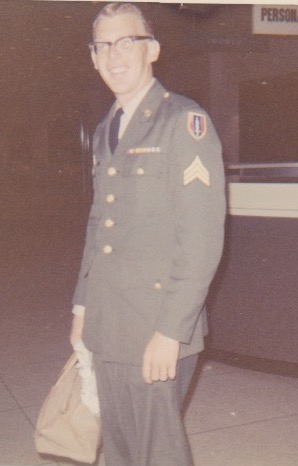
Dick is from Urbana, Illinois. He was drafted and entered the Army on April 20, 1966, and then spent the next eight weeks in boot camp at Fort Polk, Louisiana. Right after boot camp, he married his wife, Carol, and they drove off in July 1966 to Fort Gordon, Georgia, where Dick learned his Military Occupational Specialty, or MOS, which was Radio Relay & Carrier Operator. In layman’s terms, Dick set up and operated radio stations to enable battlefield communications.
It was a little unusual for a 19-year-old Private to report to Fort Gordon with his wife. It was even more unusual for this new Private to ask his First Sergeant, who is like a god to a brand new soldier, if he could live off post. Amazingly, with Fort Gordon overflowing with students living everywhere in tents, the First Sergeant gave Dick permission to live out in town. With the help of a hometown connection, Dick found a rental in the Hill section of Augusta for $75/month. At the time, Dick was making $100/month, but he also received another $100 because he was married. Carol got a job out in town and the Bergs enjoyed their stay in Augusta.
Dick completed his schooling in October 1966 and remained at Fort Gordon to await his first set of orders. They came in when he was on leave in November – he was to report to Fort Bliss, Texas. But because he was on leave, the orders were cancelled and later he received new orders – report to the Republic of South Vietnam.
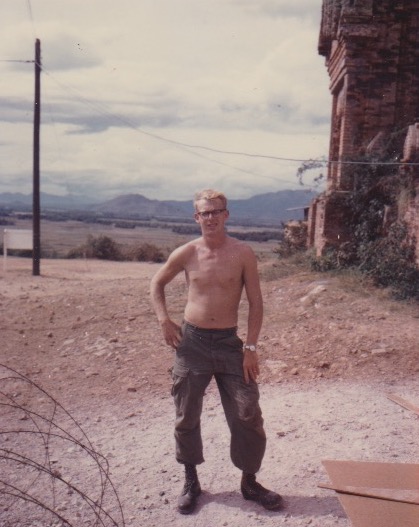
Dick arrived in South Vietnam on February 21st, 1967. He was assigned to Company B, 43rd Signal Battalion. He initially reported to Qui Nhon, which is about 401 miles northeast of Saigon, or Ho Chi Minh City as it is called today. Company B was new and Dick was one of the first 8-10 members to arrive, so he had to wait there until his company grew to sufficient strength to carry out its mission. As they built their company base of operation, Dick’s principal responsibility was to set up a radio station on a hill in the countryside about 10 miles northwest of Qui Nhon, as well as other sites, as needed.
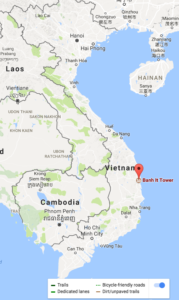 The hill was about 200 feet high and had an ancient monument, called Thap Banh It, on top of it. Dick put the antenna on the top of the tower and assembled the radio station on the grounds around the tower. Keeping this radio station up and running was Dick’s primary assignment until he departed Vietnam in February 1968.
Dick’s radio station handled tactical communications for U.S. units in Vietnam. There was another facility on the hill that had a direct line to Washington, D.C. Dick’s station was manned 24/7 by one person, usually on 10-12 hour shifts. One person also manned the other facility – so it was just 2 soldiers on this hill, pulling night shifts and manning it in all kinds of weather. During the summer, the temperature would reach a muggy 110 degrees, and during the winter, it would rain nonstop, making it impossible to stay dry. Plus, there were enemy Viet Cong all around, but fortunately Dick never came under attack. Perhaps it helped that there was a South Vietnamese camp at the base of the hill, or perhaps Dick was lucky that he got out of there before the Tet Offensive made the area hot. But he was always vigilant and always carried a weapon – he never knew when the situation might change.
Dick has many stories about everyday life in Vietnam that will resonate with veterans of all generations. I’ve picked just a few to show that you really need a sense of humor to survive in the military.
One of my favorites was when Dick’s new company commander, a spit-and-polish Captain who transferred from Germany, bought a fancy new color TV to use at the company’s base camp. He had Dick put a TV antenna up on the hill overlooking the camp, which required Dick to cut through the concertina wire around the camp to move the antenna and the cable up the hill. Once Dick got it all hooked up and the company commander turned on the TV, the picture was black and white. The company commander complained, “They told me it that it was a color TV.” It was – what they didn’t tell him was that stations in Vietnam didn’t broadcast in color.
On another occasion, Dick and a fellow soldier were on their hill drinking a beer and leaning against a guy wire securing a telephone pole. They were watching it rain up the valley about 30 miles away when lightning struck the radio station’s antenna on the monument. Not only did it zap the radio station generators, but also both men received a jolt through the guy wire. Miraculously, they were uninjured and they had the radio station back in operation within hours.
The final story involved the company commander lamenting how he’d put in the requisitions for lumber to build a barracks for his troops, but that he wasn’t getting any response. He’d tried to do this on his own, without going through his supply sergeant because he thought he’d have more success. When his supply sergeant heard this, he told the company commander to let him handle it. The supply sergeant collected 25 steaks, 50 chickens, and a bottle of Chivas Regal Scotch, and told Dick to drive at night to the port of Qui Nhon, where a ship was being unloaded. After finding the supply sergeant’s point of contact, Dick got his trucks in line and the lumber they needed was loaded from the ship onto their trucks. The three truckloads of lumber turned into a two-story barracks for 40 men. After that, the company commander relied on his enlisted leadership to get many jobs accomplished.
Sergeant Dick Berg returned from Vietnam in February 1968. He went on to graduate from the University of Illinois in Urbana/Champaign and raise a wonderful family with Carol. He credits his experience in Vietnam with helping him learn to work with all kinds of people – to listen to them – and to know what is important.
I interviewed Dick for about 90 minutes; I could have spoken to him for hours. In my opinion, Dick is an American hero and I salute him for his service. After we completed the interview, I presented Dick with a signed copy of Sapphire Pavilion, which is dedicated to Wounded Warriors and Vietnam War veterans, especially those heroes still waiting to come home.