EMP3(SS) John R. Murphy, U.S. Navy – Two Years on the USS Pompon (SSR-267)
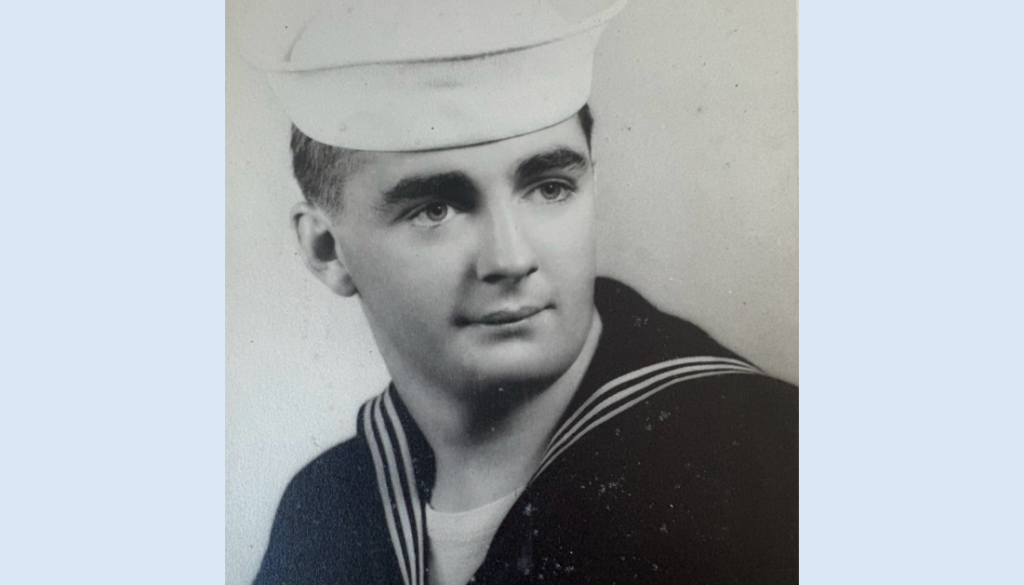
Life on a U.S. Navy submarine during the 1950s was not for everyone. In fact, it was for very few. Before sailors could serve, they had to complete rigorous training to ensure they were well suited for the cramped quarters, stale air, and constant danger inherent on a diesel submarine. The real test came when they put to sea on their first operational submarine, or “boat.” Electrician’s Mate Third Class John R. Murphy, U.S. Navy, had the rare combination of qualities needed to be a successful submariner. Those qualities also served him well in his post-Navy career. The bonds of friendship he forged with his fellow submariners continue to drive him today.
John was born in July 1937 in Lynn, Massachusetts, a city about ten miles northeast of downtown Boston. His father worked as a clerk at the local gas and electric company, while his mother worked as a part-time piano player and full-time mom to John and his two brothers.
John attended Lynn English High School, where he focused most of his efforts on studies. He tried football for a couple of years but lacked the size and motivation of his older brother. Instead, he spent his free time hanging out around town with his friends.
After John graduated from high school in June 1955, he had to decide what he wanted to do with his life. Looming in the background was the peacetime draft, which required young men like John to register when they turned eighteen. John knew that if he were drafted, he would have to serve two years on active duty. Not wanting to leave his future up to the whims of the draft board, he explored enlisting in the Marine Corps and the Army, but a bad back kept him out of both services. Then he found an opportunity in the Navy just five miles away in Salem.
Salem was the home of the USS Shad (SS-235), a decommissioned World War II Gato-class submarine used by the Navy to train reservists. John decided to join the Naval Reserve, enlisting for a total of six years, two of which had to be on active duty. He trained on the Shad with other reservists, learning about Navy customs and traditions and the submarine’s systems and operations. He also went to Gloucester, Massachusetts, to board an operational submarine, which took him and his fellow reservists out to sea for a series of dives to see if they could handle the claustrophobic environment and to give them the opportunity to observe the crew’s teamwork firsthand.
Once John had a year of reserve training under his belt, he received orders to report to Submarine School at Naval Submarine Base New London in Groton, Connecticut. There he joined a cadre of sailors fresh out of boot camp to train for duty onboard an operational Navy submarine. The training consisted of classroom instruction, hands-on experience with various types of equipment, and, of course, marching. What quite literally kept John up at night, though, was the anticipation of having to pass the pressure and escape tank tests.
The pressure test involved sitting in cramped quarters with other sailors in a hyperbaric chamber while the pressure in the compartment gradually increased. To pass the test, John had to equalize the pressure in his ears so his ear drums would not rupture. During the test, the sailor behind John tapped on his shoulder and told him his ear was bleeding. John asked him not to tell anyone because he wanted to pass the test, so the sailor said nothing. John passed.
John’s next hurdle was the escape tank test. This involved being released from a small, crowded, and flooded chamber at the bottom of a 100-foot water-filled tower wearing a Mae West lifejacket and making it to the surface safely. The key to success involved participants exhaling the entire way to the surface so the expanding air in their lungs would not cause their lungs to burst. The instructors said it more simply: “If you want to die, hold your breath.” As if to put an exclamation mark on the danger, a sailor was injured taking the test prior to John’s class. As a result, the escape tower staff limited John’s test to 50 feet rather than the standard 100-foot ascent. Remarkably, once John got into the escape tank, his fear disappeared and he passed with flying colors.
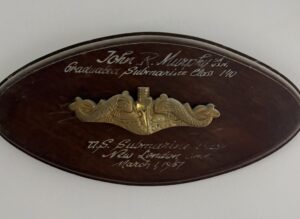
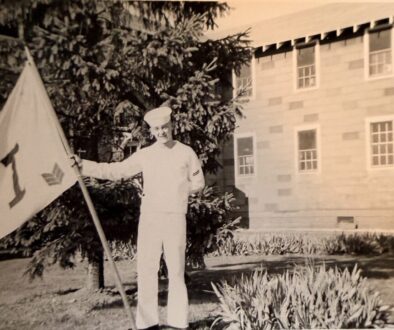
With the pressure and escape tank tests behind him, John graduated from Submarine School on March 1, 1957. His next stop was Naval Station Norfolk, where he reported for duty onboard the USS Pompon (SSR-267), another World War II Gato-class submarine. He arrived at night and found the boat tied up at the pier. The topside watch welcomed him, signed him in, and escorted him down the hatch and inside the boat to his bunk. His life on the Pompon began the next day.
When John woke up, he quickly learned that as a newly-reporting seaman apprentice, he was the most junior sailor on the boat. That meant his first assignment was in the galley peeling potatoes, making coffee, and washing dishes. At the end of thirty days, he rotated to work in the engineering spaces, learning about the boat’s diesel propulsion system and exploring the associated engineering career fields. When he completed that rotation, it was back to the galley for more kitchen duties before reporting to the Electrical Division, where he found his permanent home.
As a sailor in the Electrical Division, John had to learn about the Pompon’s electrical and lighting systems and auxiliary power equipment. As he gained experience and demonstrated proficiency, he was designated as an electrician’s mate, abbreviated EMP with the “P” representing his job subspecialty. Through hard work, on-the-job training, and passing advancement tests, he was promoted to petty officer third class and earned his submarine warfare designation, reflected as EMP3(SS). He also qualified to stand watch in the maneuvering room near the boat’s stern. There, he and another Electrical Division watchstander controlled the “sticks,” which determined the direction and speed of the Pompon’s propellers. Whenever the Officer of the Deck or the Diving Officer ordered a change in the boat’s speed or direction (forward or reverse), John and the other watchstander executed the change.
John’s skill at the sticks was put to the test when evaluators came aboard to assess the Pompon’s proficiency at sea. As part of the assessment, they shut off the electricity to the boat’s lights, making it pitch black. They then sounded the dive alarm. John and his fellow watchstander had to switch to battery power and execute the speed change orders in the dark. As if that wasn’t enough, the next order they received was for “all back emergency.” This meant reversing the submarine’s direction while still in the dark and in the middle of a dive. John and his partner executed the orders flawlessly, and the Pompon received a top score on the assessment. Pompon excelled in other areas, as well, ultimately winning the prestigious Battle Efficiency award (Battle “E”) in 1958, which the Pompon proudly painted on both sides of its conning tower.
During John’s time aboard, Pompon operated primarily off the East Coast of the United States, including in the Caribbean and the North Atlantic. However, during September and October 1957, Pompon participated in the NATO Strikeback exercise, which simulated the NATO response to a Soviet invasion of Western Europe.[1] Although the exercise was deadly serious, John got to enjoy port visits in Scotland; Le Havre, France; and Portland, England. During the Scotland port visit, Pompon tied up alongside the USS Nautilus (SSN-571), the world’s first nuclear-powered submarine. What stood out most about the Nautilus for John was that its conning tower was covered with tarps to hide damage to its periscope the submarine sustained during a secret under-ice probe in the Greenland Sea.
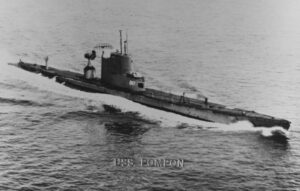
After the NATO Strikeback exercise, Pompon returned to Norfolk and routine operations and training. During one excursion into the North Atlantic near the Arctic Circle, John found himself serving as the lookout on the port side of the submarine’s conning tower during a violent storm. When a giant wave hit, John felt his feet lift off the deck. Had he not been holding onto the rail around his lookout station, he would have been swept away by the wave.
John recalls another close call when a large wave hit the boat and water poured into the submarine through the open conning tower hatch. Watching all the water flood in before the hatch could be secured sent chills down John’s spine. On yet another occasion, John remembers one of the boat’s officers hustling during a dive to secure or “dog” a stern hatch near John’s duty station in the maneuvering room. He arrived just in time, preventing the hatch from blowing open from the changes in pressure caused by the dive.
Not all John’s close calls related to large waves and open hatches. After a port call at Naval Station Roosevelt Roads in Puerto Rico during the first half of 1958, a squadron of surfaced submarines practiced firing live torpedoes at a target on Vieques Island, which at the time was home to a U.S. Navy live-firing range. When it came Pompon’s turn, John was topside with a movie camera to film the event. After the torpedo fired, it broached and started to change course, creating a dangerous situation for Pompon and the other submarines in its company. All the submarines had to quickly clear the area to avoid being damaged or sunk by the errant torpedo. John captured the ordeal on film.
John gained a special appreciation for the sailors who served on submarines during World War II when Pompon brought aboard a group of Army and Navy officers to experience what life on a submarine was like. As part of their familiarization cruise, the Pompon submerged while a group of destroyers ran parallel to it and dropped depth charges at a distance. Before each depth charge detonated, John heard a click and then felt the blast as a rush of water hit the boat. One of John’s buddies got spooked and ran by him looking for someplace safe to hide. The reality was there was no such place on the submarine. John has nothing but respect for the U.S. submariners during World War II who did so much to help win the war, but who also endured unimaginable hardships and danger.
In June 1958, John made his second trip to Europe onboard Pompon. This time, the boat operated in the Mediterranean Sea. Memorable port calls included Malta, Gibraltar, and Naples, Italy. In Naples, the crew got together for an authentic pizza party and met some local gangsters. John also bought an accordion there, which he somehow managed to get inside the boat to bring home. He later sold the accordion at a substantial profit. He was also able to take a side trip to Rome while the Pompon remained in port at Naples.
John’s most exciting Mediterranean port call occurred in Izmir, Turkey. There, he befriended a twelve-year-old Turkish boy named Zeki. He gave Zeki a tour of the submarine and introduced him to the rest of the crew, making Zeki feel like a star. This came in handy when a U.S. sailor from a surface ship visiting Izmir at the same time defiled the Turkish flag. The people in the city were so angry, all the U.S. ships in Izmir had to cancel the rest of their visit and put to sea. The problem was Pompon had not yet received food it had ordered in Izmir for the next leg of its deployment. Zeki volunteered to step in and escorted John and the Supply Officer to the food warehouse so they could pick up Pompon’s order. Although the people in the streets were not happy to see John and the Supply Officer, Zeki’s presence kept them safe until they returned to the boat with their stores.
Pompon returned to Norfolk in September 1958. John remained onboard through December 12, completing his two-year active-duty obligation. He fulfilled the remainder of his reserve service commitment in the inactive reserve. Pompon had little time left, too, as it was decommissioned in April 1960 and sold for scrap.[2]
Leaving Pompon was difficult for John because the crew had become like family to him. From the crusty chief of the boat who had served on submarines during World War II, to the sailor with big ears everyone called “Wingnut,” every crewmember was forever etched in John’s memory. Not only did they depend upon one another to do their jobs in the unforgiving submarine environment, but they also became like brothers because of their shared experience at sea. Where they came from, how much money their families had, or the color of their skin didn’t matter. Completing the mission and looking out for one another did. The bonds of friendship John forged on Pompon remain both real and strong.
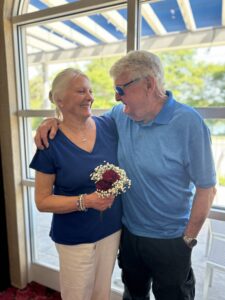
After the Navy, John used his electrician’s mate skills to land a job with the New England Telephone Company in Salem, Massachusetts. He began as a cable splicer’s helper and advanced until he became a journeyman with his own truck. He also began attending night classes at North Shore Community College in nearby Beverly, which allowed him to move to an inside engineering position. There he helped plan the telephone company’s physical expansion, like where to put telephone poles and manholes. He also married, and he and his wife had six children in quick succession. They subsequently divorced, with John retaining custody of their children. John later married Bonnie Houghton, whom he met at the telephone company, and together they raised John’s family.
John continued to rise through management, eventually working in the telephone company’s Traffic Department, which employed over 12,000 telephone operators and almost 100 managers. He then shifted to night manager, handling any issues in New England that arose after hours. Next, came an assignment in the company’s Management Training Center in Marlborough, where he became interested in the importance of listening after seeing a poster on the subject. With the help of his staff, he went on to create a mandatory two-day course on listening for operators and managers. He also became an influential member of the International Listening Association, eventually serving on its board of directors, and was a member of the National Speakers Association.
John’s final assignment at the New England Telephone Company was in the Yellow Pages division in Lynn, Massachusetts. He worked in management and sales there until he was detailed to serve in Manchester, New Hampshire, as the project manager for Dean Kamen, a prominent inventor and entrepreneur seeking to establish For Inspiration and Recognition of Science and Technology, or FIRST. John spent two years in this role before retiring in early 1990.
Later that year, John had an opportunity that recalled his time on Pompon in an unexpected way. His alma mater, North Shore Community College, was celebrating its twenty-fifth anniversary and John was asked to speak at the spring commencement. Staff at the college asked him to submit the text of his speech beforehand, but John’s ADHD prevented him from doing so. This worried the college president because he feared John’s speech would run too long. After some terse words between them, the two men walked onto the dais together. Shortly after John began his speech, the auditorium lights went out, thrusting everyone in attendance into darkness. Just like when the Pompon’s lights went out during the Battle E evaluation in 1958, John didn’t panic and told the audience to remain calm. He then completed his speech without notes, ending with an inspiring quote from Winston Churchill. Even the college president smiled.
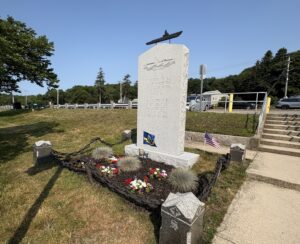
About twenty years ago, crewmembers of the Pompon held a reunion in Cape Cod. As the participants gathered at the official USS Trout (SS-202) Memorial, Wingnut started to weed around the memorial honoring all the Massachusetts submariners lost during World War II. It was then that John realized his calling to take care of the memorial, which is one of fifty-two such memorials honoring the U.S. submarines lost during World War II.[3] In the winter, John makes sure the memorial is free of snow. In the spring, Bonnie plants flowers. Together, they have cared for the memorial and its parking area for nearly twenty years. John is working now to update the memorial so visitors can interact with it and ask it questions. He believes his work is the least he can do for the sailors who lost their lives onboard submarines during the war.
Voices to Veterans is proud to salute EMP3(SS) John R. Murphy, U.S. Navy. John served on the USS Pompon when tensions between the Soviet Union and the United States ran high. He became an integral member of a well-trained crew, each member depending upon the others to do their duty under the most difficult circumstances. Now he honors the submariners who went before him by maintaining their memory on the USS Trout Memorial. We thank him for all he has done and wish him fair winds and following seas.
If you enjoyed John’s story, please sign up for the Voices to Veterans Spotlight monthly newsletter by clicking here. Once each month, you’ll receive a new written veteran’s story directly in your mailbox. Best of all, it’s free and you can unsubscribe at any time.
[1] Wikipedia, s.v. “Exercise Strikeback,” last modified May 19, 2026, https://en.wikipedia.org/wiki/Exercise_Strikeback.
[2] Naval History and Heritage Command, “Pompon (SS-267),” Dictionary of American Naval Fighting Ships, U.S. Department of the Navy, https://www.history.navy.mil/research/histories/ship-histories/danfs/p/pompon.html.
[3] Each state has one memorial, with California and New York each having two.